Animals Australia: the voice for animals

Animals Australia: the voice for animals
Love life? Love all of life
Showing posts with label Farmers Markets. Show all posts

Saturday, October 17, 2015

Celebrating Fair Food Week at the Jiggety-Jig Farmers Market in #Ballarat

I trotted off jiggety-jig to market, this morning. 
No, I didn't buy the fat pig of the nursery rhyme. 

Being vegetarian, I steered clear of the meat that was available
and focussed on bread and veges. 

 The Jiggety-Jig farmers market was on this morning. 
 Local producers. 

 It costs a little more to purchase the food available at good farmers' markets 
but it is worthwhile to spend a just a little extra 
to purchase local food of good quality 
which has not travelled far from the farm; 
where you can be absolutely guaranteed that free range eggs 
are actually free range.

It is also wise to remember that
if we don't support our local producers and makers
then, one day in the not too far away,
we will lose them.
If we lose them and make ourselves slaves
to imports and cheap foreign government subsidised food,
with these people will go the skills that
ensure that we can feed ourselves.
So purchasing from the locals
is like making a down-payment on
a sort of food insurance policy.

Below is an album of my purchases. 
Some good eating is contained therein 

Friday, April 26, 2013

This week-ends markets in Victoria - 2013-04-27 and 2013-04-28


Fourth Saturday-Sunday Markets


4th Saturday
WhereWhenEntryNotes
Ballarat LakesideWindmill Drive, Lake Wendouree, Ballarat9am-1pmfree2nd and 4th Saturdays, except December - 2nd Saturday only
BentleighEast Bentleigh Primary School, 90 Bignell Road, East Bentleigh8am-12.30pm$2 entry4th saturday excl. January; 
Casey-BerwickThe Old Cheese Factory, 34 Homestead Road, Berwick8am-12.30pm
Dec 20th from 4pm to 8pm
Churchill IslandChurchill Island, Phillip Island8am-1pm
Every Saturday during January - 8th, 15, 22, 29
Hume MurrayGateway Village, Lincoln Clauseway, Wodonga8am-12pm
Every 2nd Saturday from Jan 8th
Keilor EastCentreway Park, Wyong Street8am-1pm
Starts: November 24th
LancefieldCentre Plantation, High Street, Lancefield9am-1pm
3rd Saturday in December
MansfieldMansfield Primary School, Bottom Terrace. Entrance off Highette Street, Mansfield8.30am-1pm
No Market in January
MontyMontmorency Primary School 60A Rattray Road, Montmorency9am-1pmgold coinentry proceeds go to Primary School
MyrtlefordSt Paul's Anglican Church, Clyde Street, Myrtleford8am-12pm
Each Saturday - January to May; 1st/3rd Saturday - June to December
NewtownCnr Shannon Avenue and West Fyans Street Newtown Geelong8am-1pm

PrestonBell Primary School
Corner Scotia St and Oakover Rd, Preston
9am-1pm
$2

children free
Slow FoodAbbotsford Convent, St Heliers Road, Abbotsford8am-1pm$2Parking:$2
Taste of Gold - MonashMonash University Clayton Campus Car Park8.30am-1pm
moved from Holmesglen TAFE; no market January
TraralgonKay Street Gardens, Kay Street, Traralgon8am-1pm

TorquayTorquay Central, Bristol Road, Tourquay8.30am-1pm
every saturday
YarravilleYarraville Gardens, Cnr Hyde and Sommerville Roads, Yarraville8am-12pm


4th Sunday
Where
WhenEntry
Notes
Fitzroy-St KildaCorner Fitzroy St & Lakeside Drive8am-1pm

Flemington (ex Melb Showgrounds)Debney Park Secondary College,
169 Mt Alexander Road, Flemington
9am-1pm
Every Sunday; restarts 9th January 2011; Parking $3
KinglakeIn the Shed, cnr Heidelberg/Kinglake Road and Healesvill/Kinglake Road9am-2pm
Ex Yarra Glen Railway Market
ManninghamThe Manningham Club
1 Thompsons Rd, Bulleen
8am-1pm
gold coin donation
Mt. ElizaCnr Mt Eliza Way and Canadian Bay Road, Mount Eliza9am-1pm
No market in December
MulgraveGrounds of the Body Shop, Cnr Jacksons & Wellington Rds Mulgrave8am-1pm
Every Sunday;
YarrawongaPiper Street, Yarrawonga8.30am-12.30pm

Wednesday, March 06, 2013

Speaking of spuds 1: road testing the Russet for chips (not fries. Le's speak Oz!)


Further to the post below about the Bridge Mall Market last Saturday, 
I want to speak about spuds.

Please go to Poh's Kitchen on the link above to discover
the range of potatoes available in Australia


I purchased some Russet potatoes from a family stall - mum, dad and all the kids enthusiastically explaining the virtues of the great variety of spuds on sale.  The Russet is not on Poh's list linked above. I usually purchase an unwashed general type of potato such as the Sebago. The recommendation from the potato stall was that the Russet was excellent for chips.  So I tried them out and found them rather especially good for chips.

 I don't usually peel potatoes.
I scrub them.
Above are the scrubbed and sliced russets, ready for cooking.

The russet chips frying in virgin olive oil.

Here is some of the finished product.
The russet chips came up wonderfully good.
Crisp on the outside but neither too soft nor too mushie on the inside.
I highly recommend the russet.
Perhaps Poh might find some and see if she can confirm my judgment.

Sunday, March 03, 2013

Buying local at Bridge Mall Ballarat

Click on collage and open in new tab or window for a larger view.

Yesterday I did my vege shopping at Bridge Mall in the CBD of Ballarat.
Lovely stuff.
As well as colourful stalls and kids activities,
the animal farm was there.


Tuesday, August 17, 2010

GIRLS' DAY OUT AT MORNINGTON : BAY HOTEL

Herself and I had a girls day out to-day. We drove to Mornington. First of all, we stopped for lunch at the Bay Hotel.  You can see the bistro section - which was beautifully warm and toasty - on the right of the collage above. We checked out the menu:
We had certainly picked our day because we were able to avail ourselves of the Monday/Tuesday Special which meant that if we picked a "starred" item we got it for $15 with a complimentary glass of wine.  I know I don't dine out often these days, Trad Padders, but I hadn't come across a cleverly marked menu such as this.  Along with the stars, the menu sported tiny 'v's for vegetarian and 'gf's for gluten free.  I am vegetarian and I appreciated this thoughtful touch and I am sure the gluten free brigade would too. I ordered Mediterranean Pappardelle which, ordinarily according to the menu, has chicken.  I asked for the dish without the chicken and they were happy to oblige.  So my pappardelle came with roasted vegetables, pan seared with olive oil, tossed through the pappardelle and sprinkled with feta and toasted pine nuts.  Herself - who is a carnivore - ordered the Hopkins River Beef Burger.  I didn't have the wine.  Herself had mine and I had a coke.  She seemed well pleased with her vino.  I noted that The Bay promotes local Mornington Peninsula wines with other Australian wines bringing up the rear.  So, as you can see, we had good provender.

If you want to get the rest of the story about what we did in Mornington, please go here.
Photobucket

Sunday, August 01, 2010

Farmers Markets : Grow Local

Just a reminder to Tucker lovers, 
to check out their local farmers' markets.

In Victoria, you are never far from a farmers' market and there is a website to check your market of choice.    It may be a market close to home or you may decide on a pleasant drive to a pleasant location.  Have fun - and buy your food, as far as possible, close to home to support the Grow Local idea and make sure your victuals have as much of the good stuff in them as possible when you get to eat them.  

And if you want to swap stuff or meat like-minded people, please pop over to the net site, Grow Local.


Photobucket

Friday, July 04, 2008

We are what we eat? And our food eats what...?

A new phrase for the vocabulary. CSA - community supported agriculture. Does anyone know of anyone doing this here? Here at The Trad Pad, we are familiar with Aussie Farmers Direct. And great as this is, it doesn't give a personal relationship with the person who produces the food. Do we think it matters if there is a personal relationship? But then if I don't know the farmer, how can I be sure of land practices, etc. And if land practices are an issue - and think salination of the soil in Australia, not to mention erosion and then the land 'development' where we place MacMansions and BogunVillas on prime agricultural land - and there is a personal relationship, a knowledgable and concerned consumer may be able to influence, may be able to exercise valuable decisionmaking at some point in the journey from land to plate. Land degradation can have a direct affect on food security - not only in this rich, developed country but in some of the poorest, underdeveloped nations on earth. Food security is an issue: a slow burn for us in Australia, a fast burn and possibly a big bang for those in poor countries. Figures just released by the FAO, show that there were 50 million more people hungry last year. Not 50 million - but 50 million more, in addition, plus what there was before. Australia, the driest inhabited continent on earth, has been facing - courtesy of the longest and most extreme drought in living memory - the water issue. The release of the Draft Report of the Garnaut Review on Climate Change now extends our focus to climate. Emissions trading is well and truly on the agenda - and one of the biggest questions is whether agriculture will be included. We have yet to consider how all this might affect our own food security and cause us to question whether we are self-sufficient and secure in our food production.

Wednesday, January 16, 2008

Ethical eating: Animal, Vegetable, Miracle

Firstly, let me declare my bias. I am a Barbara Kingsolver fan. I haven't read everything she has ever written - but quite a lot from her first novel, The Bean Trees, through to her most recent work, Animal, Vegetable, Miracle written in collaboration with her husband Steven Hopp and her elder daughter Camille Kingsolver and ably and practically assisted by the youngest family member, Lily Hopp.
Kingsolver's pictorial representation of a Year of Local Food eaten seasonally - The Vegetannual.
Please reverse months for the Southern Hemisphere

Animal, Vegetable, Miracle is subtitled Our Year of Seasonal Eating. It could, as easily, have been subtitled "How to Organise Your Local Food Menu". The Hopp-Kingsolver menage resolved to eat locally and eat seasonally - within the parameters of traditional food preservation methods. Their resolution included a determination to move from long-time residence in distance transport dependent Tucson, Arizona where the water travels long distances as do the fruit and veges and much else that supports modern life there. Fortunately, Steven Hopp long possessed a run-down farm and farmhouse in the Appalachian Mountians of Virginia.

There has been mention, some critical, of the magical or fairy tale quality of Kingsolver's description of the family's Appalachian lifestyle. I do take issue with this. If her description sounds magical, fairy tale, or idealistic, perhaps it is because it speaks to an ideal or fantasy within ourselves which is imbued with such qualities. True, not all of us - even if we wished - could replicate the Kingsolver-Hopp project. This family was particularly well resourced in more ways than one.

For starters, they did not risk their livelihood. Kingsolver has a high profile as a writer - not least because her best selling Poisonwood Bible was featured on that automatic provider of best selling status, Oprah's Book Club. One presumes that this provided some sound financial resource. Hopp is Adjunct Associate Professor of Environmental Studies at Emory & Henry College in Emory, Virginia which is classified as a college that changes lives. Biology appears to be a family interest as Camille Kingsolver includes it in her studies at Duke University. Lily was too young to enter into a book contract but she, too, was committed every inch/centimetre of the way.

Secondly, they had the Appalachian farm - with house - which Steven had owned for a long time. Not everyone has one of those tucked away in their Glory Box.

Thirdly, they brought scientific training and literacy to the project. Having such skills backing the project has to be a plus.

Fourthly, the necessary resource of the free labour of three adults and one enthusiastic child. One adult (although she was absent at college for large chunks of the project) was young with, one assumes, the energy to match her age. Kingsolver and Hopp were hardly over the hill. I mention this because at my great age and antiquity I can get tired just thinking about consistent, strenuous, and demanding activity.

Lastly, the motivation of the entire family is a great spiritual resource. There is nothing quite like energetic, resourceful people reinforcing one another in their mutual resolve. It provides large quantities of fuel for the journey, particularly when the going gets tough or you wonder why you ever set out on the journey - although there did not appear to be much self-doubt in the Kingsolver-Hopp unit.

So, when these factors are present, I see nothing magical, fairy tale, or idealistic about Animal, Vegetable, Miracle merely a wonderful, imaginative, determined, and sensible use of resources by two people in mid-life. The Kingsolvers and Hopps appear to have done the project very well, very intelligently and in a well recorded manner - complete with detailed website. For those who wish to emulate them, there is a clear trail to follow.

Some of the clear, factual information provided in AVM is shocking:

Humans have eaten some 80,000 plant species in our history. After recent precipitous changes, three quarters of all human food now comes from just eight species with the field quickly narrowing down to genetically modified corn, soy and canola.

Garden seed inventories show that while about 5,000 non-hybrid vegetable varieties were available from catalogs in 1981, the number in 1998 was down to 600.

Hardly good stewardship of the planet's resources, is it?

The last chapter about the turkeys had me all but rolling on the floor with laughter - until the final paragraph when I was in tears. But it was life and death stuff Kingsolver was describing. The life and death of the re-creating pro-creating skills of created beings. If plain statistics make your eyes glaze over, the life and lot of an American turkey will not. Perhaps one day a futuristic Dr Strangelove will have wreaked the same havoc on humanity as has already been visited on the American turkey. It is our choice. Our questions, our demands, our very own actions will be the deciders. We can eat and die or we can eat and live.
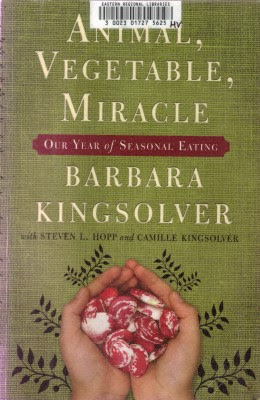
I will be returning my copy to the Upper Ferntree Gully Library this afternoon, dear Reader, so get ye down there and check it out (641.0973 KIN). If it has disappeared from the shelf, great. Just get the friendly staff to put a hold on it.

It will take me a while to process all the information contained in AVM. For instance, I am a vegetarian and, for me, ahimsa/respect is a huge issue. My main motivation is the disrespect shown to animals by the industrial food chain. Kingsolver provides a rationale against vegetarian/vegan lifestyles in favour of respect and gratitude for animals while killing them for food. I do agree with her - in principle and in necessity. In reality, would I move to her side of the fence? I don't know.

Animal, Vegetable, Miracle is another contribution in the genre of think about what you eat or, in brief, ethical eating. We have philosophers, locavores, the 100 mile diet, seasonal eating, and the slow food movement. Kingsolver points out that when the family embarked on its project locavores and the 100 mile clubs were unknown. By the time the AVM was published, everyone was talking about ethically eating.

My view is that Prodigal Summer and Animal, Vegetable, Miracle should should be read in tandem. The first (written earlier than AVM) is fiction, the second non-fiction but each informs the other. Prodigal Summer deals with some issues that are not dealt with in Animal, Vegetable, Miracle. Some issues dealt with in Animal, Vegetable, Miracle are dealt with more explicitly and graphically in Prodigal Summer. Otherwise, what else is fiction for?

Sunday, October 07, 2007

Aussie Farmers Direct

Herself has signed us up. First delivery is yet to arrive. Someone knocked at the door - and it seems like a great way to support our farmers. You see in Australia our grocery retailing is in the hands of a duopoly - Woolworths and Coles. There are independents - an Australia wide one IGA and locally there is Maxi. Here at The Trad Pad, Maxi is our preferred grocery retailer but we do shop at Woolworths when it suits - for very good specials or a particular product. You see we don't want to give most of our grocery dollar to supporting the market dominance of Woolworths - not only in groceries but in hotels, liquor retailing, and poker machines. What do you think, dear Reader, when you see the Roll Back poster in Woolworths proudly boasting that they are rolling back prices? Miss Eagle thinks there are two possibilities:
  1. This is untrue - and prices are not rolling back i.e. when are they rolling back to? - are they rolling back on every item or only some items?
  2. This is true - but how is the rolling back being done and at whose expense? Stories persist of farmers being squeezed; of farmers being flooded with paperwork as Woolworths imposes their auditing procedures upon them. And what about employees - are their wages and working hours and intensity of work being squeezed too? Are suppliers being forced to cut and cut their prices to get shelf space to put their products up front?

Miss Eagle suspects that the answer to each question is in the affirmative. Woolworths are progressively introducing their trendy looking house brand, Select. Some stories are around that Select is gradually taking shelf space away from other wholesalers. In other words, Woolworths are not giving existing suppliers a fair deal. Dear Reader, if you are not already taking time to check the labels on all the products that go into your shopping basket - please do so from now on. To whom are you transferring the power of your grocery dollar vote? Towards Australian business and employment or to foreign businesses who do not pay their employees well, who do not meet appropriate environmental standards? If you think this is exaggerated, Woolworths had to answer questions recently about Select brand toilet paper which had its source in unsustainable forest harvesting.

As a consumer, dear Reader, are you prepared to be relieved of what power you might have and give the decision-making to large corporations to make decisions in their own interests which, in the end, may not be in your best interests?

So, here at The Trad Pad, we are willing to give Aussie Farmers Direct a go.

Tuesday, November 21, 2006

Knox Farmers Market

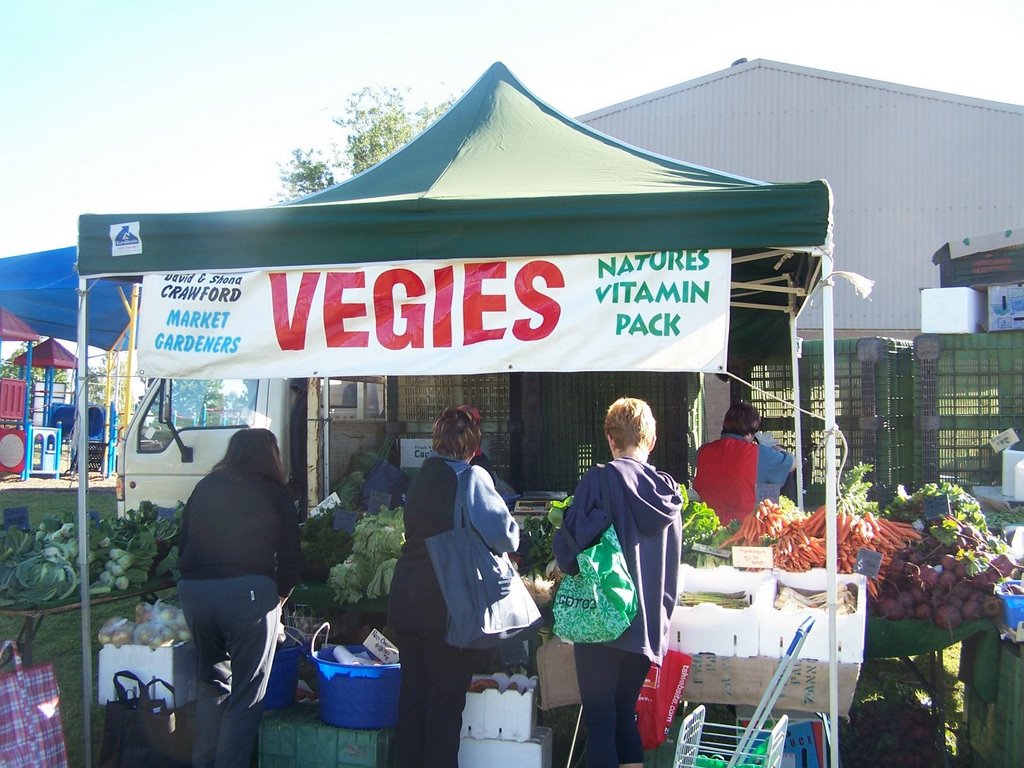
Miss Eagle is ambivalent about Farmers Markets.
Since Farmers Markets arrived on the scene in their current form in the late 90s, they have had a great impact. Farmers Markets provide an outlet direct to the public for growers and producers - particularly for those growers and producers with new products and innovative ways of doing things.
But what does that mean for better food and ethical eating? A lot of the food is still reliant on the slaughter of animals. Organic meat is still slaughtered flesh.
And if your expectation is that all food/products will be organic: 't'aint necessarily so. Some is, some isn't. But the intent is there to provide high quality food, reasonably priced (not necessarily cheaper), to the consumer in a direct relationship with the grower/producer.
This intent is probably the best thing about Farmers Markets - if, and only if, it helps both the consumer and the grower/producer to ask questions about their food/products.
Miss Eagle likes the direct involvement. One of the problems with modern food production is that consumers in general haven't a clue about how their food is produced and how it comes to their plates. Karl Marx highlighted the alienation of workers from the means of production. Modern food production highlights the alienation of consumers from the production of their sustenance.
Even at a Farmers Market the consumer still needs to be aware and questioning. Take the opportunity to have a conversation with those selling you your food. Your conversation could lead to better and healthier food for all of us.
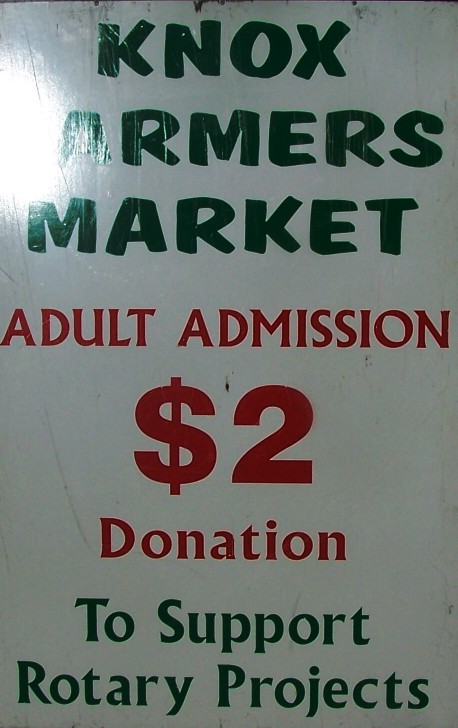
Boronia Rotary Club organises the Knox Farmers Market at Wantirna Primary School, Melbourne. The next market is on 16 December.

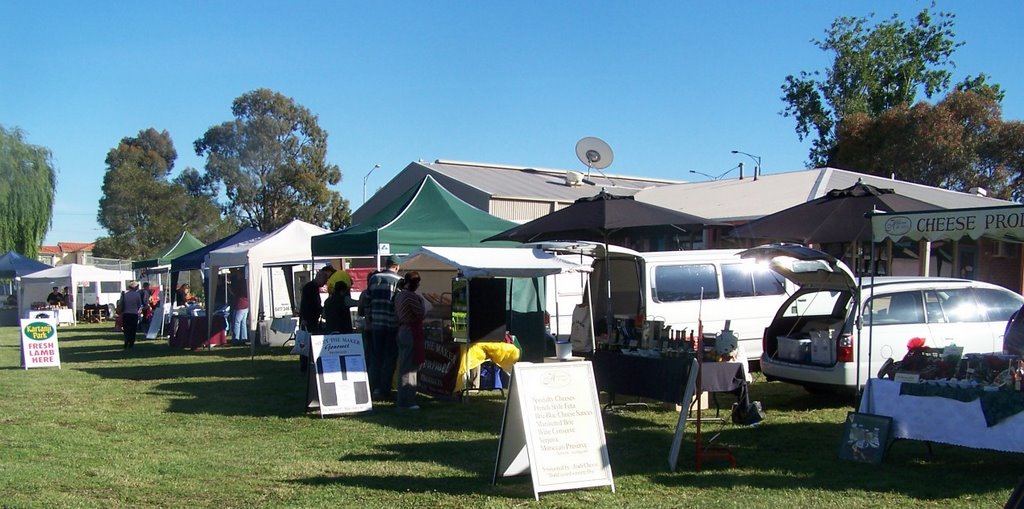
The Knox Farmers Market was formerly at St Joseph's in Boronia Road. The new venue means everything is well laid out and last Saturday was a beautiful sunny and cloudless day after a week of extremely cold and unseasonal weather.

ShareThis