Animals Australia: the voice for animals

Animals Australia: the voice for animals
Love life? Love all of life
Showing posts with label Seafood. Show all posts

Tuesday, January 17, 2012

Sustainable Seafood Day on March 16, 2912


Seafood sustainability is one of today's major issues. Australians need confidence that our magnificent supply and range of seafood will be there for generations to come. Duncan Leadbitter reports on an eco label which is helping consumers make the right choice to ensure that sustainability, and alerts us to the inaugural Sustainable Seafood Day on February 17, 2006.

Seafood is health food and consumers want more - and the Federal Government is urging Australians to eat more - but there are limits to what the ocean can provide. For many fisheries around the world, those limits have been breached. Over the past 30 years the number of overfished stocks has tripled and now one in four fish stocks are overfished.

At the end of last year the Federal Government announced a major restructure of the south-east fishery, with a $220 million buy-out to secure fish stocks and guarantee a profitable industry. According to a recent survey by the Bureau of Rural Sciences, the Australian Federal Government's main research arm, 40% of Australian consumers think that commercial fishing is unsustainable, and 57% of the consumers surveyed believed that the provision of a sustainability label would influence their purchases.

One solution is third-party verification of sustainable fishing practices, such as the eco-labelling certification provided by the Marine Stewardship Council (MSC), an international non-profit organisation. Through the work of the MSC, Australia is taking steps towards producing a global solution to a global problem. Politicians, scientists, food industry educators and high-profile chefs have all pledged their support.

To carry the MSC logo - a tick of approval - a fishery must undergo a rigorous certification process. This blue oval logo is a way for concerned consumers to see at a glance whether the seafood products they buy are sourced from sustainable fisheries, which are commercially-driven partnerships delivering both community benefits and sustainable ecological benefits. The MSC now has 14 fisheries certified to the MSC Standard globally. This may not sound like much but it includes the world's largest managed fishery (for pollock in Alaska), and covers Alaska salmon, pollock, New Zealand hoki and South African hake. There are also smaller-volume and higher-value species available such as Western Australian rock lobster. Indeed, there are now about two million tonnes of fish available globally which could carry the MSC's sustainability label - which is 10 times the entire Australian catch.

European retailers are avidly catering to consumer interest. The MSC's blue trade-marked logo is currently displayed on more than 280 products in 24 countries. In Australia there more than 30 MSC-labelled products for sale - mostly frozen and canned offerings - and there are plans for more. The world's first fishery certified to the MSC's strict environmental standard was an Australian fishery, the Western Australian Rock Lobster Fishery, and several other Australian fisheries are currently undergoing the certification process. Food service remains an area where consumer interest is not yet being satisfied, despite the availability of sustainably certified hake and hoki.

While acknowledging the Federal Government's recent initiative of a national seafood education campaign, "What's so healthy about seafood?", in response to research which shows that Australians are eating less seafood at home, from the Marine Stewardship Council's perspective, ensuring that consumers can buy tomorrow the fish that was available today is critical to the health of the industry and the environment.

The MSC is urging Australians who love their seafood to participate in the inaugural Sustainable Seafood Day to be held in Australia on February 17 to raise awareness of responsible fishing practices by demanding evidence of sustainable fishing practices from their seafood suppliers. Increasingly, the MSC will become the name associated with a global solution to this problem by establishing an environmental standard for well-managed and sustainable fisheries.

Duncan Leadbitter is a respected Australian marine biologist and an FMCA member.

"The seafood industry has long had the reputation of being high on the list of anti-environmentalists in the food industry, and while sadly this can remain the case in certain fisheries and individual enterprises, the actions of the MSC are proving that the industry must, and can, change. The commercial benefits of providing sustainable, environmental supply in the contemporary seafood world are real - a third party independent certification of this provides consumers, end-users and the trade with the security that this is a genuine endeavour. Like never before, there is a need for the MSC to be encouraged, respected and endorsed by the seafood industry, not only for the absolute moral position we must take for the future of our planet, but clearly if we plan to be a growing part of modern food supply." John Susman, Bizzfish, Sydney

"Gone are the days when we could consider our wild-caught fish as a limitless resource. In the 23 years I've been involved in the food industry, it has been obvious that fish  populations are dwindling. The Marine Stewardship Council's work goes a long way in assuring all of us as consumers that the management of fish stocks is being handled in a sustainable manner, so that we can continue to enjoy our seafood." Steven Manfredi, Manfredi Enterprises

"I commend the whole blue-label MSC accreditation system which allows consumers to make an informed decision on buying fish that they know have been environmentally responsibly managed. The social and environmental cost of overfishing is a very real and sobering issue. Ensuring that a sustainable supply of our local fish will be there for future generations to enjoy in their diets is an imperative legacy." Catherine Saxelby Consultant Nutritionist

"If we as Australians are to continue to enjoy the beautiful fresh and healthy harvest of our waters in the years to come, we must ensure that our fisheries are managed sustainably. I congratulate the Marine Stewardship Council - it has an important job ahead of it. It would be irresponsible to endanger any of our marine life because of thoughtless human greed and myopic management of this precious and delicious natural resource, which we take for granted will always be on our plates." Margaret Fulton OAM
Further reading:
(get an app for your iPhone here)


Wednesday, June 06, 2007

Over at The Elegant Sufficiency, Stephanie has drawn our attention to a grave ethical problem in the eating habits of human beings. Miss Eagle is a great lover of Chinese culture and food. Chinese cuisine is the pinnacle for Miss E. But Miss E deplores the depredation of whole species to meet Chinese demands for exotic foods and traditional medicinal ingredients. Miss Eagle's health has not been the best in recent times and she has considered resorting to traditional Chinese medicine - but there is a major hurdle. The impact of Chinese medicine on animal life. Read here and here to add to your understanding, dear Reader.
However, while one can recoil in horror at these tales, one also has to question our own Australian ethics in regard to our Standard Australian Diet.
We are wrecking our land. None of us question that anymore. Part of the wrecking of our ancient and fragile soils has been the importation of hard hooved animals. Sheep and cattle undergird the carnivorous diet favoured by most Australians. Goats and camels run wild in large numbers in the inland of Australia far from the eyes of the comfortable congregating in the urban fringes. The Northern Territory sends more cattle overseas in the inhumane live export trade than find their way to Australian slaughter houses.
What are the ethics involved in supporting the diet of most Australians?
For information about beef, cattle, sheepmeat, sheep, and goats go here. If you want to know more about live animal export, please go here.
As Jim Mason and Peter Singer point out (see sidebar), ask questions about your food - where it comes from, the means of its production - and ask questions about the treatment of animals and survival of animal species. Animals share this planet with us. We owe it to them. We owe it to ourselves.

Wednesday, May 16, 2007

First catch your ironing board....

Miss Eagle thinks that Ian Parmenter and Christopher Lawrence have taken leave of their senses. Christopher Lawrence had Ian Parmenter on 936 ABC Local Radio in Hobart with a recipe for Ironed Salmon. Whoever heard the like! The first instruction Method is "Turn the iron on". Depending on how you like your salmon done you can opt for either the linen setting or the cotton setting. Whoda thunk it!?!

Sunday, May 06, 2007

Deep-sea bottom trawling

A major issue in our food chain, for our ethical eating, and - not least - for our environment and planet, is the way our sea food comes to us. We purchase our sea food in a variety of forms - fresh, frozen, canned and processed as ingredients in sauces and pre-packaged dishes. Many species are being fished out - either across the globe or in specific locations. Those consumers paying attention to what is happening are a minority.
Humanity will finish up with little seafood and the ocean a desert. If, dear Reader, you think that fish farming as a replacement for fish in the wild is a solution you need to have a closer look at the consequence of that for us and for the environment.
So one wants to be encouraged by what has just happened in Chile where China, the United States, France, Japan, Chile and South Korea were among the countries signing an agreement to impose restrictions on deep-sea bottom trawling from October until a full scientific study can be undertaken on the effects of bottom trawling. At time of writing, Miss Eagle has not been able to obtain a full list of signatories.
The agreement covers a quarter of the world's oceans and will restrict fishing vessels from dragging huge weighted nets across the sea floor. Except for the tuna fishery, the South Pacific high seas are essentially 'free-for-all' fishery.
Miss Eagle assumes that Australia was present at the meeting - but this has yet to be confirmed. Also to be confirmed is whether Australia is a signatory to the agreement. One assumes that Australia was there and is a signatory the agreement because of our role as a member of the Deep-Sea Defenders. Greenpeace has a compiled a Bottom Trawling League Table.
For three years, Greenpeace has worked with the Deep Sea Conservation Coalition and its 60 member organisations to get a global moratorium on the destructive fishing practice of bottom trawling in the high seas.
Japan, China and South Korea have signed this recent agreement: three nations in the whole of Asia. [If this is incorrect it is because of lack of details] Miss Eagle wants to know what Taiwan, Thailand, and Malaysia are doing.
Check your labels, dear Reader. If it is confirmed that a particular nation is not a signatory to the Regional Fisheries Management, please check your labels and the source of your fish and boycott products from nations who are not signatories to the agreement.
Otherwise, you are a contributor to the cycle of detriment to this planet. You are a contributor to the desertification of our oceans and species destruction.
For more information, dear Reader, on seafood sustainability you might like to go to the following sites:

Tuesday, April 10, 2007

Stream of consciousness stew

In The New Yorker, Adam Gopnik regales us with real food from fictional recipes. His survey of food, recipes, cooking takes us from Trollope, through Proust, to J.D. Salinger and Ian Fleming. Kurt Vonnegut and Nora Ephron are included. Gunter Grass and The Flounder are emphasised. Robert B. Parker's Spenser mysteries get a starring role. But the full explication of Gopnik's theme and thesis is through Ian McEwan's bouillabaisse recipe in Saturday - more properly known as Henry Perowne's Fish Stew. Gopnik highlights the difficulty with using cooking as the stock for the stream-of-consciousness stew. Method by method he points out the impossibility of preparing the ingredients for the bouillabaisse while giving deep thought to the events leading up to the Iraq War. Former backgrounds for stream-of-consciousness writing such as walking and driving are quite appropriate. But cooking. Actually, wandering off into a lengthy, rational, and literary stream-of-consciousness is just not possible. See what you think, dear Reader. And to help you decide you might like to try Henry's fish stew:
Henry Perowne's Fish Stew
From Ian McEwan's novel Saturday with revisions by the author.
Note: Where quantities are not stated, trust your instincts or desires.
Into a stockpot of boiling water (a litre or more), put the bones of three skates (or other boned fish) with heads intact. If you have no obliging local fishmonger, use a pound or more of white fish.
Add a dozen or so mussels to the stock. Simmer for twenty five minutes.
Meanwhile, strip and chop three onions, and eight fat cloves of garlic. Soften over a low heat in a casserole with a lot of olive oil.
When they've melted sufficiently, add:
  • a couple of crushed red chillies,
  • a pinch of saffron,
  • some bay leaves,
  • orange-peel gratings,
  • oregano,
  • 5 anchovy fillets,
  • 2 cans of peeled tomatoes.
When these have blended together in the heat, add a quarter bottle of white wine. Then strain off the stock and add to the casserole.
Simmer the mix for twenty minutes.
Rinse and/or scrub the clams and remaining mussels and place in a bowl. Cut the monkfish tails into chunks and place in a separate bowl. Wash the tiger prawns and add to the monkfish bowl. Keep both bowls refrigerated until ready to cook.
Just before dinner, reheat the casserole.
Simmer the clams, monkfish, mussels and prawns in the casserole for ten minutes.
Eat the stew with brown bread, or garlic bread, salad and a hearty red wine.

Thursday, May 18, 2006

On the menu 1: Saucy Seafood & Lemon Pudding

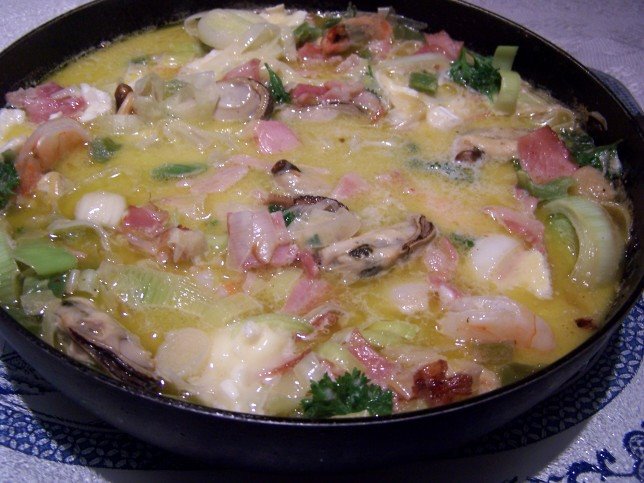
Saucy Seafood
This dish is for those who love shellfish. As the nights get cooler in the Southern Hemisphere, it is a cosy main course. It is a variation on Brie Mussels, provided by Clarice over at Storybook Woods. And while you are there, have a look at Clarice's take on How to roast a chicken. Very interesting and very creative.
SAUCY SEAFOOD 3 bacon rashers with rind removed 1 leek - or replace it with 2 onions Fresh garlic. Mis Eagle loves heaps. 1kg shellfish - this comprised green mussel meat, green prawns, and scallops, debearded
1 cup dry white wine (or water but wine is better) 1/2 cup heavy cream 1/4 cup chopped fresh parsley 2 tablespoons Dijon Mustard 1 ( around 8-ounce) brie, very cold, rind removed and cut into pieces

In a large pan fry bacon and set aside crisped bacon. Drain off most fat. Keep 1 tablespoon and add oil. Sautee leeks/onions until tender, about 5 minutes. Add the garlic, 1/2 the parsley, and bay leaf and cook, stirring, for 1 minute. Add the shellfish, wine, and cream, and bring to a boil. Cover, lower the heat and cook, shaking the pan occasionally, about 5 minutes. You will know when the shellfish is cooked when the green prawns turn red. Remove from the heat. Discard bay leaf. Stir in Dijon. Add cheese, crumbled bacon, rest of parsley. Pour into a large, deep serving bowl. Serve immediately with hot French bread for dipping and lemon wedges.

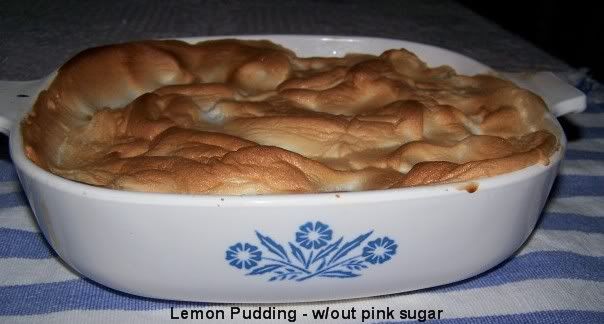
And for dessert, straight from Miss Schauer and The Schauer Australian Cookery Book is something quite old-fashioned, Lemon Pudding.

Photobucket - Video and Image Hosting

LEMON PUDDING

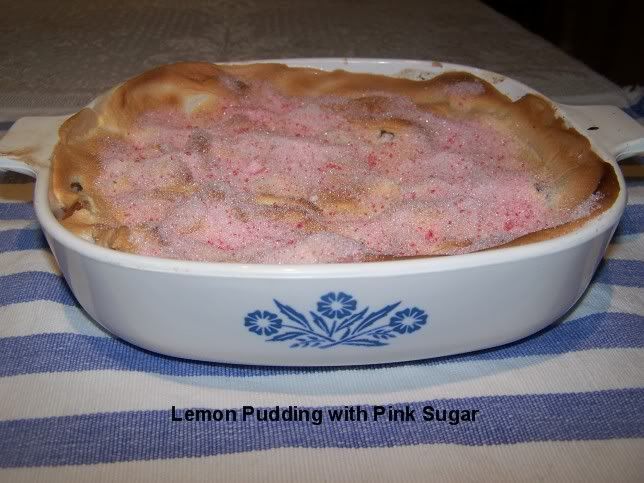
Grease pie-dish. Butter bread, cut in dice, put 3 layers at bottom of pie-dish. Melt 2oz. of butter in a saucepan, add the juice of 2 lemons and the rind of 1, add 1 cup sugar, small cup water, the yolks of 2 eggs, beat well. Put into oven to set, then place meringue on top, sprinkle with pink sugar.

Miss Eagle's Notes: Yum yum. Luscious. However, would suggest an extra white for the meringue. Felt it spread a bit thin. An extra yolk into the mix would go well.

MISS EAGLE'S MERINGUE

Bowl and beater should be cool and dry. When separating whites from yolks, there must be no skerrick of yolk polluting the whites. Unless Miss Eagle is doing large quantities, she prefers to use her favourite rotary beaters (see previous post). Beat whites until stiff (they will be a soft-ish sort of stiff) and then add caster sugar a dessertspoon at a time to taste. The adding of the sugar slowly and beating well in before each addition gives the stiffness to the meringue. All sugar should be beaten well in so that no grain can be detected. After placing on pie, return to oven which is very low and leave meringue to set and brown slightly.

Photobucket - Video and Image Hosting

MISS EAGLE'S PINK SUGAR

Take about 2 tablespoons of sugar and add about two drops of red food colouring or cochineal. Mix in with a spoon. Colouring should be used very sparingly to give the sugar its pale pink colour. A little goes a long way. If you don't use the full amount, the rest can be stored in a jar for use next time.

ShareThis