Animals Australia: the voice for animals

Animals Australia: the voice for animals
Love life? Love all of life
Showing posts with label Schauer Australian Cookery Book. Show all posts

Saturday, November 05, 2011

Vintage Cookbooks and Miss Schauer


I have recently discovered the wonderful Vintage Cookbooks at Kallista in the Dandenong Ranges just east of Melbourne.  Now, Vintage Cookbooks are open only three days a week - so you can't always take advantage of those bookshelves jam-packed with cookery treasures.  However, you can shop at their site on line any time you like.  Books have pictures and extensive descriptions.  However, remember that you are entering the world of collectibles and items are priced accordingly.

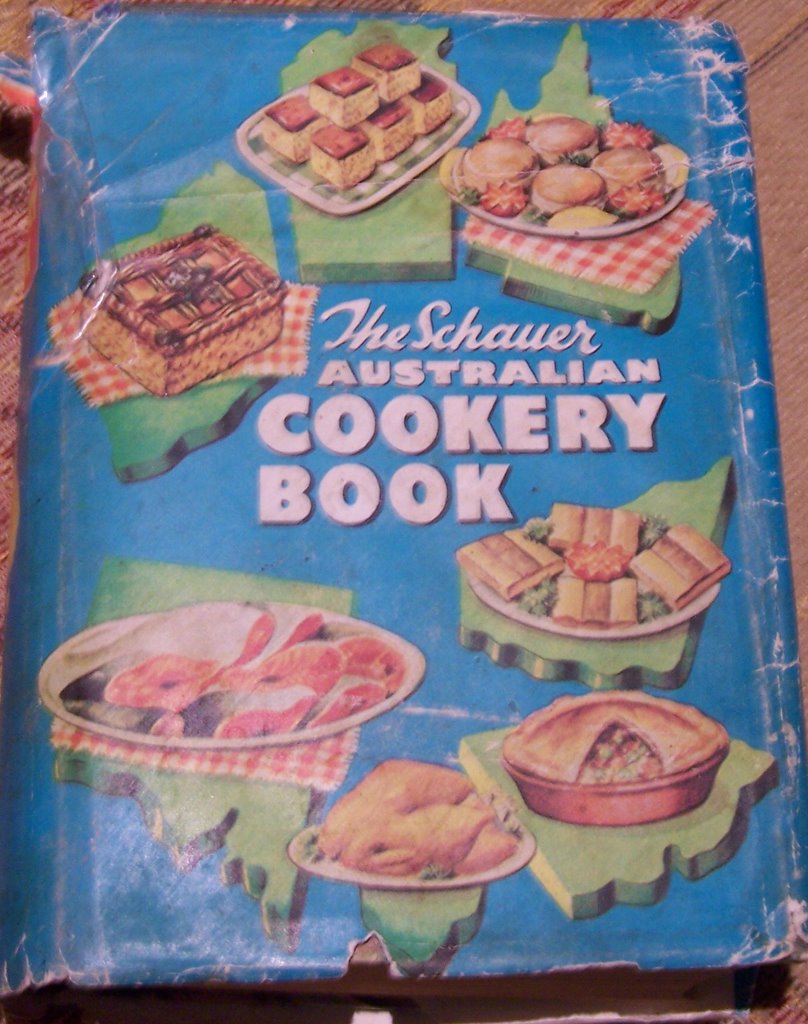
The standard of the treasure impressed me because - guess what? - they have an old, old, copy of Miss Schauer's Cookery Book looking nothing like the photograph on this blog. 

 
Click to enlarge

Monday, August 16, 2010

Bias in the kitchen as discovered by The Wheeler Centre

This book accompanied The Australian Women's Weekly
March 8 1967.
Have just discovered that I blogged about this book
here over four years ago. And there is a recipe there too.

Bias in the kitchen as discovered by The Wheeler Centre here in Melbourne.   The Wheelers  have a lot to say about the Top 50 Best Cook Books as listed by The Observer.

As Tucker Lovers know, Miss Eagle does not stand on ceremony and Posh Nosh is not really her thing unless it can be brought to manageable household proportions and method.

I learned to cook in Domestic Science classes as the Bowen State School.  Added a bit more to the repertoire when I had to cook meals for everyone when I was on night duty at the Bowen Hospital.  But the real crunch, for most of us, comes when we marry and have a family and we have to learn, produce, and budget meals day by day, week by week, month by month, year in and year out.  We balance likes and dislikes, time and reality.  So my two nominees are never going to make it on to The Observer list but I need to express my undying and unflagging gratitude to them.

  1. Coming in at Number 1 is Miss Amy Schauer and her Schauer AustralianCookery Book.  No surprises there, eh, Tucker Lovers.  
  2. I am also indebted to The Australian Women's Weekly Test Kitchen Team/s.  In his review of Kitchen, Benjamin Christie says: Many of you would have grown up with those thin 60 page Woman’s Weekly cookbooks in your kitchen. Well, I am so antique that I precede those.  I come from a period when the books (and their were craft books as well which taught me to knit for babies, toddlers and children - yes my skills grew with the kids thanks to The Weekly) were rectangular affairs of about 14 pages stapled into the inside of The Weekly - which really was a weekly back then, not a monthly as now.  I kept heaps of these for many years but eventually, after shifting around half Australia, I parted with them.  I still have a couple which are not just yellow but brown with age and the pages are decidedly tattered.  And I just remembered, after the rectangular affairs came a sort of B5 size one which was sophisticated by comparison.


Photobucket

Thursday, August 09, 2007

Wednesday, August 08, 2007

Jam Drops - from thumbprints or fingerprints

Woof Nanny recently posted on what she referred to as an American Classic - the thumbprint cookie. I knew immediately what she meant and the photograph confirmed it. Because, after all, it is an Australian Classic - the Jam Drop. And the recipe I am about to give is from that other Aussie Classic, Amy Schauer, in my family's cooking bible: The Schauer Australian Cookery Book.
APRICOT OR RASPBERRY DROPS
Cream 4oz butter and 4oz sugar to a cream, add 2 well-beaten eggs, beat well in. Add 6oz sieved flour and 6oz cornflour, 1 level teaspoon of cream tartar, 1/2 teaspoon crush bi-carb. soda. Mix well through, roll into small balls with the fingers, and make a smal well in the centre of each with the finger-tips; in this put 1/2 teaspoon of raspberry or apricot jam, and place on cold floured tray. Bake in quick oven 10 to 15 minutes until a golden brown.
Miss Eagle's Notes
  • I prefer a little less cornflour and use 8 oz plain flour and 4 oz cornflour
  • I place the biscuits on a greased and floured tray
  • A quick oven is a hot oven - so about 200 or 220 degrees Celsius - and keep any eye on them
A must for the biscuit barrel or cookie jar

Monday, June 11, 2007

Apple Rhubarb Pie

Rhubarb is around and Miss Eagle decided to indulge in a memory from childhood of my mother's friend, Delia Brazil, and her rhubarb and apple pie. Miss E used Flaky Pastry for the pie case, made from scratch. Miss E is fussy. She doesn't object to store-bought Filo or Puff Pastry. These really are time consuming, take practice to get right easily, and - in these days of small kitchens - space could be an issue. For Miss E, you need a good excuse to purchase frozen Shortcrust Pastry. In these days of dough hooks for the mixer and the wonders of food processors, there really is little excuse for not making your own. Now Miss Eagle wishes to advise that between shortcrust and puff pastry there is another category: that of Flaky Pastry, sometimes known as Rough Puff Pastry. Now you would not dash home from work and rustle up this pastry for the evening meal as you could with shortcrust. However, you can make it ahead of time and keep it in the frig for later use. And certainly, it is a pastry worth making for special occasions and special guests. The recipe and instructions here are from our beloved Miss Schauer - she of The Schauer Australian Cookery Book. First, we will look at Miss S's instructions.
  • PUFF, FLAKY OR ROUGH PASTES are folded and rolled repeatedly to increase the amount of cold air held between the layers. Puff paste must be rolled in short forward rolls, never backwards and forwards. The rolling pin must be lifted between rolls. Puff pastry must never be rolled over the edge as this may force out some of the cold air. The ends and edges must be secured by being turned over a little and pressed heavily with a rolling pin.
  • Puff pastry is allowed to stand between rollings, in an ice-chest, refrigerator, or cold place, covered with a buttered paper to prevent crust forming. [Miss E doesn't use buttered paper. She puts it in the frig in a plastic bag.] This is done in order that the butter may harden and thus keep layers of paste and butter separate.
  • In warm weather, puff pastry, when rolling should be placed on a marble or cold slab cooled by ice or very cold water, i.e. wash over and dry before using.

Then to Miss Schauer's recipe:

FLAKY PASTRY
Sift 1/2lb plain flour with 1/4 teaspoon salt into a mixing bowl. Make a well in centre, pour in a full teaspoon of lemon juice, add 1/2 cup of very cold water. Mix with a cold knife. Turn on to a floured board, knead lightly into an elastic dough. Divide 6oz of firm butter or lard into 3 equal portions. Roll pastry into a large oblong piece. Put one third of firm fat all over surface in small pieces. Fold into 3 by bringing top of pastry into centre, the bottom end of pastry right up to the top. Turn so that open ends are top and bottom. Run floured hands up each side of pastry to keep quite even. Secure edges by pressing heavily with a rolling pin to shut cold air in. Press fat in a straightforward light roll from within edge to within edge, never over. Fold into 3. Make one finger mark to show rolled once. Put away to get cold 30 minutes. Fold and roll twice more in exactly same way with 30 minutes to cool between. Fold and roll the fourth time without fat to size required ready to use.
~~~~~~
ASSEMBLING THE PIE
by Miss Eagle
  • Divide the pastry into two parts: one piece 1/3 in size (top); the second piece 2/3 in size (bottom) and line pie dish. [Please note: Miss E's pie dish measures 25.5cm in diameter and 5cm deep. To ensure sufficient pastry, Ms E used 10z flour with other ingredients modified accordingly.]
  • Peel, quarter and slice 3 Granny Smith apples and spread one of these apples neatly on the pastry around the base of the pie dish. Top and tail rhubarb and chop stems into pieces about an inch long. Place these on top of the apples. Then spread remaining two applies sliced on top of the rhubarb.
  • Sprinkle the fruit thoroughly with brown sugar.
  • Sprinkle with lemon juice - use sufficient to flavour fruit not to soak the pastry base.
  • Place 6 cloves evenly around the pie.
  • Cover with pastry lid.
  • Trim pastry and use left overs for pastry decoration
  • Glaze. Miss E uses milk.
  • Bake in a very moderate oven - approximately 175 degrees Celsius. The pie should take 30 to 40mins to bake to ensure the fruit is cooked through.
  • Cool and served with custard. Miss E's was made with No Egg according to the recipe on the packet.
  • Miss Eagle used PureHarvest Organic Nature's Soy as an alternative to milk. Miss E buys this by the slab at Friends of the Earth in Fitzroy; Woolworths Naytura Soya Margarine Spread; and Orgran Gluten Free No Egg Natural Egg Replacer from Maxi.

~~~~~~~~~~~~~~~~~

Scrumptious and satisfying served warm on a cold, rainy evening.

Sunday, June 10, 2007

Teacake Australis: #2

When Miss Eagle discussed teacakes here, Val sent me her recipe which she, in turn, got from the lovely Kali. Miss E can highly commend it. It is a little different in that one separates the white of the egg from the yolk and whips the white. The sagacious Miss Schauer has only one tea came in which yolk and white is separated. She calls it a Special Teacake. Miss E will give recipes for both. Miss E baked the cake in a 20cm(8") springform pan. The pan specified for Val and Kali's recipe was smaller - 18cm (7"). There was one deviation from the recipe. Miss E had in the pantry a blend from the McCormick range of Orange, Cardamom and Vanilla so she sprinkled this over the cinnamon/nutmeg teacake. It was lovely - providing a lovely contrast to the cinnamon and nutmeg in the cake.
CINNAMON TEACAKE

Ingredients

  • 1 cup self-raising flour
  • 1/2 teaspoon cinnamon
  • 1/4 teaspoon nutmeg
  • 1 egg, separated
  • 1/2 cup sugar
  • 1/2 cup milk
  • vanilla essence (about a capful)
  • 1 ½ tablespoons butter, melted
  • extra melted butter
  • 1 teaspoon cinnamon
  • 1 tablespoon sugar

Method

Sift the flour with the 1/2 teaspoon of cinnamon and the nutmeg. Beat the egg white until stiff. Add the egg yolk and mix in. Gradually beat in the 1/2 cup of sugar. Slowly stir in the milk and vanilla essence. Stir in the sifted dry ingredients, with the melted butter.

Spoon into a greased 18cm (7 in) round sandwich tin and bake in a moderate oven for 30 minutes. While still hot, brush the top with extra melted butter and sprinkle with the teaspoon of cinnamon mixed with the tablespoon of sugar. Serve warm or cold, with butter.

MISS SCHAUER'S SPECIAL TEACAKE

Separate yolks from whites of 2 eggs. Beat egg whites stiffly, add a pinch of salt, beat in the egg yolks, beating for about 5 minutes. Then slowly add 1/2 cup sugar and beat till dissolved. Add slowly 1/2 cup of milk. Sieve in a cup of self-raising flour. Add 1 tablespoon of melted margarine. Pour into a greased 8 in. sandwich tin. Bake in a moderate oven 25 to 30 minutes. While hot, spread with a little butter sprinkled with brown sugar and cinnamon.

Friday, May 05, 2006

Miss Schauer on Scones

B One of the delights of The Schauer Australian Cookery Book is that, at the beginning of each section, Miss Schauer gives tips and rules. So, dear Reader, even if you choose not to use her recipes but choose to use someone else's, it is wise to consult the notes at the beginning of the relevant section. So here is what she has to say at the beginning of the section headed Scones, Pikelets, Etc., and Baking Powder Bread:
SCONES
Buttermilk is excellent for mixing scones. Sour milk, using 1/2 teaspoon of bi-carb soda to each cup of sour milk or 1/2 milk and water. A yolk of egg beaten into milk with pinch of sugar makes scones richer. (Also cream with milk.)
NOTE:- A sharp knife or a sharp round 2in. cutter must be used for cutting scones; also a hot tin to place them on. They must be placed in oven immediately they are finished. Plain white or wholemeal flour, with 1 heaped teaspoon baking powder to 1 cup, or plain white, Cerevite, or wholemeal self-raising flour may be used in all scone making. All white flour must be sifted twice. Wholemeal and Cerevite must never be sifted.
Rules for Scone Making
Sift the flour, salt and baking powder twice. Rub the butter in lightly with the tips of the fingers. Make a well in the centre. Add all the milk at once. Mix into a moist dough, with a knife. Turn out on to a floured board. Knead for a few seconds. Press out with a floured hand, about 3/4 inch thick. Cut out with a round cutter or sharp knife. Place together on a hot greased tin. Brush over either with milk or egg and milk. Bake in a hot oven from 10 to 15 minutes. Turn out into a clean towel and allow to stand still cold.

Tuesday, November 15, 2005

My Cooking Bible

My cooking bible is The Schauer Australian Cookery Book. My aunt, Bina Doneley, used it as did my mother, Phyll O'Carroll. I find that few Australians have heard of it. Yet the work of its author is famous and one of her recipes is an Australian icon. The Schauer Australian Cookery Book is written by Amy Schauer - usually known as Miss Schauer. Miss Schauer taught generations of Queensland Domestic Science teachers. Her iconic work is the Lamington. I remember seeing an interview on TV some years ago with famous Australian artist, Lloyd Rees. He was then about 93 not out. He said that he remembered when he was about 13 years of age (before World War I) growing up in Brisbane, he was at a friend's place one afternoon playing tennis. Miss Schauer arrived. She was a friend of the family. She said that they had done something interesting that day at College. They had made something completely new - the Lamington. For those who don't know, the Lamington is a square of cake covered in chocolate icing and then covered in dessicated coconut. There is little on the 'net about Miss Schauer but I have found this snippet of history.
Another much shorter research project took place in 1933. M. Goode, Manager of Peanut Products, a Queensland company, forwarded a sample of peanut paste for experimentation to the Domestic Science Department. Miss Amy Schauer, officer-in-charge of that department and author of a highly successful cook book, prepared a luncheon using the peanut paste in every item, and thus increased the sales potential of the product.
I love Miss Schauer not only for her wonderful "standard" recipes but for her advice. The book - very plain with no photographs, not even of the author - is divided into categories. At the beginning of each category, there is general advice on the principles of cooking the particular item. For instance, in the section on souffles, there is a whole page of advice including the guiding principle of using one white more than the number of yolks. Even when I am using someone else's recipe I will refer to her advice before embarking on the project. The Schauer Australian Cookery Book is still in print. I am on my second copy because the first one fell to bits. Second-hand shops also turn up copies.

ShareThis