Animals Australia: the voice for animals

Animals Australia: the voice for animals
Love life? Love all of life

Sunday, November 30, 2008

Seasons of the Soul: Advent 1 2008

From website, www.earthsong.org.au

We are being called into a new place and our creativity is being placed at the service of Earth, in a new millennium and a new moment.

There is an awakening of deep energy, for embracing the interconnectedness of the whole life community and finding the place of the human within this community.

Living within the Divine Mystery, we celebrate the sacredness of all beings and the integrity of all creation.

Drawing on the wisdoms of our past, we are moving into new expressions of our response to the creation: 'groaning in one great act of giving birth'.

We seek to learn new ways, widening our horizons, believing in a possible dream, touching into our deepest experience to give and to receive life.

Photobucket

Sunday, November 23, 2008

Action and absence

I have been gone so long: too long in fact.  However, I do have some good excuses - oops, that's reasons.  It more or less started back toward the end of July.  There was a meeting held at Temple Beth Israel at St Kilda to discuss the establishment of an interfaith/multi-faith environmental organisation.  The idea for this had been sparked in Jewish/Christian/Muslim dialogue.
The July meeting attracted a liquorice all-sorts of faith adherents - and they were keen to see an organisation such as that mooted get off the ground.  GreenFaith Australia was born.  The main drivers were Rabbi Jonathan Keren Black of the Leo Baeck Centre and Elyse Rider, a post-graduate student at Monash University studying interfaith dialogue.
Those in attendance had an opportunity to sign up to about eight different areas of interest.  We could sign up for more than one and I signed up for 'Events' and 'Lobbying and Activism' - areas in which I had skills and experience.  And it went from there.  Along the way, I skipped a meeting - the one where the organisation and roles were established - but next day I was asked to consider being Secretary and leading the Lobbying and Activism Group.  I agreed - and then we were off an running.  
Our first Event took priority: launching GreenFaith Australia on an unsuspecting public!
We decided to launch ourselves in November with three consecutive seminars under the heading of Water for Life to be held on 6, 13, 20 November.  So, what is the first thing a good secretary does?  Set up a data base so that all and sundry can be notified of the event.  
Before I go any further, let me get sidetracked to tell you how I got sidetracked.  
There are times when my immune system goes off the rails.  At the end of September/early October - in the middle of the launch planning and preparation - a severe case of cellulitis in my left ear and face put me in the Angliss Hospital for six days where I was the tourist attraction of the Short Stay Unit as nurses and doctors who were not working in the unit came to look at the monstrosity of an ear on the side of my face.  I got over that only to suffer further and varied infections through to mid-November.  Needless to say, that knocked the stuffing out of me.  
Then in all that, we had to be out of our house by 10 November because our landlords wanted to come back and live in the house:  and we were having difficulty finding a house that would give us the space we needed.  In the end, we were unable to find a house in good old Upper Gully - and the lovely house we have found is twenty minutes away from the mountains and closer to urban action.  So there I was juggling illness; trying to pull my weight in the house shift; and organising mail-outs, speakers and peripherals for the launch.
Any wonder that the absence from blogging has been prolonged.
In the middle of all this, Belinda has tagged me - with wonderful compliments!  I am stunned.  I haven't been out of touch with Belinda - even if I haven't kept up with her blog - since we have corresponded by email with she making generous offers of baby sitting my veges and herbs; of offering me growing space at her place if I couldn't garden.  So generous and hospitable.  
The Launch is over.  The speakers have spoken, the facilitators facilitated, the questions have been asked, and the ideas have been mooted.  Whew!  We met some wonderful people: speakers, audience, people who want to join us on our GreenFaith journey.  It seems it is going to be quite a journey.
If you are interested in joining GreenFaith Australia, please email greenfaithmelb@gmail.com.
Our 2009 schedule is beginning with involvement in the Sustainable Living Festival at Fed Square from 20-22 February and will conclude with a presence at the Parliament of World Religions here in Melbourne from 3-9 December 2009. 
Talk to y'all later.
 

Monday, September 08, 2008

My personal jury has long been out with regard to organic food. Not that I have anything against it - but the price. I can't afford to source all my food organically - although I give it a try with The Trad Pad garden, free range eggs, my fair trade coffee, and - most recently - fresh milk. And, though I am vegetarian, I purchase the occasional free range chicken for the family. Who can afford organic food from the supermarket or 'boutique' organic store? Certainly not a low to middling income family with a number of hungry mouths to feed.
Having said that though, one has to take into account our food and how it is distributed. Most consumers would see Coles and Woolworths - our major Australian duopoly - as supermarkets. But in this day and age they should be seen not merely as retailers but as major distributors and key players in the supply chain of our food from farm to family. If this, dear Reader, has not already crossed your mind then you really need to pop over here for the real story.
So when one understand the demands of the modern retailer/distributor and the modern consumer, there is a lot than happens betwen paddock and plate. The key word here is consistency - in quality and supply. But there is another horrible word that comes into things and that's the squeeze - of market dominance of the duopoly over suppliers.
Adventurous souls have developed organic agriculture and Biological Farmers of Australia (BFA) is a major organization in this regard. BFA also has a small producers program under the auspices of the Organic Growers of Australia. Certification is the watchword of both organizations.
The reason for this explanation is that to counter my problem - price - there needs to be consistency in quality and supply backed up by certification - a sort of quality guarantee - to get into the big distribution chains where price will start to become competitive and make a difference to consumer decisions - my decisions. I am already headed that way because sustainable farming of organic food is the only way to go for the health of our land and the health of our selves and our families. As they say, good food is the best medicine and we are what we eat.
The Australian Organic Market Report (AOMR) is now out. A copy of the executive summary can be downloaded via aomr_2008_exec1[1].pdf. The report was independently researched by the University of New England’s Organic Research Group, and commissioned by BFA. It is based on industry-wide survey data and builds upon research published by the Federal Department of Agriculture, Fisheries and Forestry (DAFF) in 2004. And it is good, good news.
There is an 80%+ growth in organic farm gate sales since 2004. The BFA's members must be doing something right because this growth comes in the midst of the most severe drought since Europeans settled this country in the late 18th century.
Here are some of the reports findings:
  • Retail value (incorporating imports and adjusting for exports) was estimated for the first time above $0.5B. Retail value reached $578,000,000 with reports of between 10 and 30%+ growth per annum for some sectors since the last report in 2004. (See the AOMR for specific sector values)
  • 2007 farm gate values were estimated to be in excess of $231,000,000 – an 80% increase on the 2004 DAFF research findings.
  • With 11,988,044 hectares, Australia accounts for the largest amount of certified organic farmland in the world, the majority of which is used for extensive grazing.
  • Major retailers now carry in excess of 500 different organic lines in fresh and grocery categories.
  • The number of certified organic operators has increased by an annual 5.2% average net over the last 5 years, during a time of ongoing decrease in overall farmer numbers in Australia.
  • In 2007 the total number of certified organic operators was 2750 – made up of farmers, processors and marketers. Almost three quarters of all operators are producers, representing 1.5 - 1.8% of all growers in Australia.
  • The average age of an organic producer in Australia is lower than a non-organic producer.
  • The organic industry is consolidating and the average size of organic farms has increased, highlighting a trend towards professional farming at a larger scale, and farm area expansion by operators experiencing long-term success in utilising organic systems.
  • Horticulture remains a major stay of the industry. Some two thirds of organic farmers make up this sector which represents almost half of the total organic farm gate value in Australia.
  • Fresh produce remains the primary ‘point of entry’ for new organic consumers.
  • Despite widespread drought, farm gate sales have risen by over 80% as an average across all sectors since last reported in 2004. Grains and broadacre livestock were most impacted by drought, effectively decreasing the reported average for industry overall.
  • 40% of consumers now buy organic food at least on occasion.

So the end result of this means that there is increasing consumer demand for organic products, supply issues are being addressed, and there is every likelihood of achieving competitive price mechanisms which will be attractive to consumers. In other words, it looks like more people will find organic produce more accessible and more affordable. This is great news

Wednesday, August 06, 2008

Transfiguration

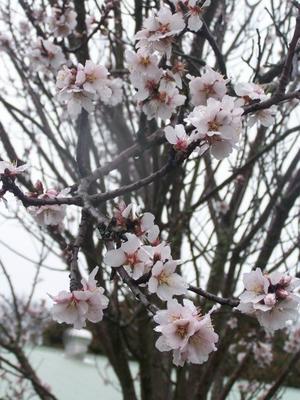
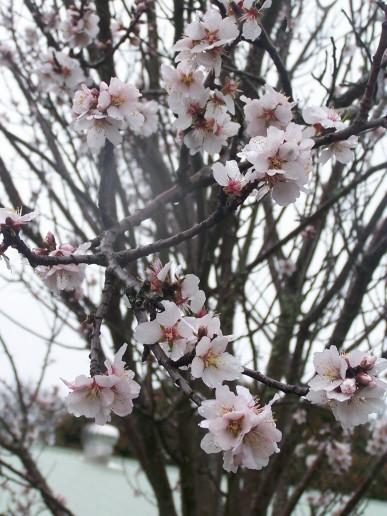
To-day is the Feast of the Transfiguration. Three years ago, the fruit tree beside my home office window was covered in blossom (the picture is from 2005) but my fruit trees have very few blossoms at this time and my magnolia seems to have blossom as a permanent condition since they have been there so long without flowering.

In the Northern Hemisphere, Easter coincides with new life in nature. In the Southern Hemisphere, Easter happens in Autumn when the leaves are falling and nature prepares for Winter.

I love the Feasts but, on those occasions when we observe those that are not Easter and Christmas, I think we talk about them in a way which does not give any depth to the experience. I think that, in the main, this is how the Transfiguration is treated.

The Transfiguration was a supernatural event intervening in the natural order of things. It was transforming and predictive of the new life to come. Just like the Southern Hemisphere is experiencing at this time. How wonderful then if people in the south of the globe could take this great season of the soul and transform it to mirror the wonder of regeneration that is happening in the environment. We could then experience both the transfiguration of our environment and of our spirits.

But I do have one question.

All good feasts deserve the best, most celebratory, most evocative food. Imagine: if we celebrated the Transfiguration what food would we serve? What would our hospitality provide? And if we gave gifts, what would we give? What would we give that turns our hearts to the spirit, to creation and away from commercialism? Please have a think and let me know.

The Transfiguration Lyrics

Monday, July 28, 2008

Highlighting the food trip to the table

Last week, Belinda had a great piece about the truckies' - at that time - forthcoming protest. This post is a wake up call to the way we live and take for granted the food on our plates and the way that food is distributed to us. Below is the beginning of the protest in Brisbane (photo: Brisbane Times)

Meanwhile, over at the major distribution chain - that you might have thought was merely a retailer - called Woolworths they don't appear to be all that bothered. But then one would expect a major corporation to have scenario planning for such events.

As for the protest, it will be interesting to see how long it lasts and what it will achieve. It is a cut-throat world out there in owner-driver land - and my guess is that for every driver that stops to protest there will be two more movin' on and out down the road.

But, as Belinda reminds us, it is well to think how we could live in another way. Human beings have decided to make our food system what it is to-day. Human beings could decide to do it differently and give ourselves a whole different quality of life - and do away with the resource wars of death and destruction fighting for oil and gas (for these read Iraq and Afghanistan).

Sunday, July 20, 2008

In the Winter Garden

I want to take you for a wander through my Winter Garden.
It is a garden of small patches; nooks and crannies;
odd spots and plants in pots.
I am amazed because I haven't gardened in winter before.
I usually hide indoors.
But there are bits and pieces that have survived,
there have been things to be tended,
and there are things that keep on keeping on.
This is the rosemary bush which is really a small tree.
It is blooming profusely and somewhere in there are bees
busy doing what bees do.

But just as there are plants in bloom,

there are others that are dormant.

The fruit trees have been pruned and
now the prunings have to be managed and disposed of.

In Melbourne, we get our rain in winter.

And we have been getting plenty.

The last week however has been like spring - and it's July! The Broad Beans are growing so they are now much higher than in this photo.

The curly parsley was planted last summer and just keeps on.

And this silver beet is huge and spectacular and quite an ornament -

so I haven't touched a leaf!

There are others though which I have used -

and fresh leaves keep coming.

The flat-leaved Italian parsley is branching and spreading.

And the lemons are productive -

and the possums have a taste and leave a half-eaten lemon on the tree

This is the golden marjoram - a relative of the oregano

which I have growing everywhere.

This one below is in a pot but rooted into the ground

right near this lot of garlic

The capsicums of summer struggle

near the wild violets

And this sweet little sugar loaf cabbage is setting a heart

This beetroot is the only survivor planted in summer in a spot that was too shady.

Rocket regrowth.

What we didn't eat or give away was left to bolt and self-seed.

Now we have a winter crop of young greens.

The sage always looks sad in winter but survives. These plants are three seasons old and will come back beautifully.

Lemon balm in a barrow

The Lemon Thyme braves the winter elements (above)

while the common Thyme (below) is undercover.

And FootFoot eyes off the nasturtiums.

Almost no flowers but the leaves are the size of saucers.

So with all this, more seeds have been ordered

as The Trad Pad prepares for Spring.

Wednesday, July 09, 2008

Photo by Karen at Picasa Web Albums
I'm sorry but these nasturtiums are not mine. My nasturtiums are rampant at the moment but only have one or two flowers - because it is winter in the Land of Oz. I have to tell you though that my nasturtiums leaves are far, far larger than those in Karen's picture. Which, I think, ought to make them excellent ingredients for the Nasturtium Pesto featured on this post at The T-Cozy.

ShareThis