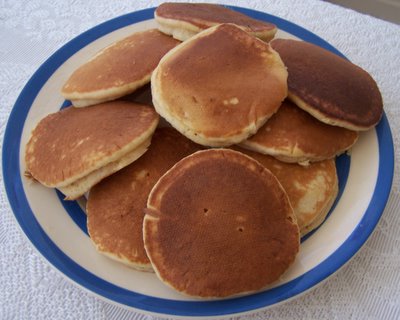
My mother, Phyll O'Carroll, once cooked so many pikelets for a church fete that she was thereafter known as Mrs O'Pikelet. Back in the 1950s she found the recipe in Brisbane's
The Courier Mail. Pikelets can be eaten as is but are usually served with butter and honey or butter and jam and whipped cream. My favourite jam on pikelets is blackcurrant. Lovely for a ladies afternoon tea when you get out your pretty china with the pink roses. The recipe:
PIKELETS
Ingredients: 2 cups of SR (self-raising) flour; Salt; 1/2 cup sugar; 1/2 tablespoon Golden Syrup; 1 egg; 1 cup Milk.
Method: Sift into basin the flour, salt and sugar. Add 1/2 tablespoon of Golden Syrup. Beat egg into 1 cup of milk and beat into flour mixture until a smooth batter is formed. Drop in spoonsful onto a heated griddle or frying pan.
TIPS
My grandmother had the view that re-constituted milk was best for cooking. This means using either powdered milk or evaporated milk. This means that you can less or more milk to the liquid than the recommended strength. I think that she thought it would make for lightness in a batter.
With this recipe, I sometimes choose to add more flour or more liquid. Consistency can vary as the ability of flour to absorb liquid can vary.
The longer batter is left the better. Overnight is always best for pancake or pikelet batter. Bubbles form in the batter to let you know it is nicely aerated.
When dropping in spoonsful, use a dessertspoon and drop the batter from the pointy end - not from the side. Hold the spoon still in the same place as the batter drops. This forms a nice rounded shape. Dropping from the side gives untidy peculiar shapes.
If using a frying pan, choose one with a heavy solid base. Cast iron is probably best. This holds the heat and gives an even heat.
Do not use too much oil. Pikelets are not fried. Oil is only used in sufficient quantity to prevent the pikelets sticking to the pan or griddle.
The pikelets are ready to turn over when bubbles come up in the batter and pop and the edges of the pikelet are firm.
I use a pointed spatula which has a bit of a spring in it to turn the pikelets.
The cooked pikelets are lifted when cooked to a dinner plate which has an overturned saucer in its centre. Now I don't know why this is done. My grandmother did it. My mother did it. I do it. I think it may be that the pikelets lie on a slant and are unlikely to stick one to another.
Postscript 31/5/6: Miss Eagle's sister, The Director, has decided to weigh into the the last tip about the saucer. You will notice, dear Reader, a greater air of certainty in her words on the subject.
Now - Miss Eagle - i would never have thought i could know something that you don't ............why do you put the saucer upside down on the plate for the pikelets.... it is about condensation and moisture, not about the pikelets sticking together. Next time you make some and you have a nice pile on your plate domed over the saucer with the tea towel wrapped over it, wait till they cool and take them off and lift the saucer, there will be a little puddle of water under the saucer from the steam trapped by the wrapped tea towel. The saucer stops the pikelets on the bottom getting soggy......there you are.......

 A Trad Pad crop


