Animals Australia: the voice for animals

Animals Australia: the voice for animals
Love life? Love all of life
Showing posts with label Jams-Jellies-Chutneys-Preserves. Show all posts

Sunday, February 07, 2016

PASSATA MAKING DAY AT BALLART COMMUNITY GARDEN - JOIN IN


Picture above from here
together with how to make passata if you can't get to the class
listed below at Ballarat Community Garden.

The post below is from Better Together -  Passata Day

Saturday 28nd February 2015, 9 a.m. sharp-till ?

Once more into the Red! Ballarat Community Garden will be hosting a passata (tomato bottling) day on the 20th of February. Come learn how to preserve tomatoes and enjoy a day of work, fun and community. We'll have a meal and share a good time! Participants will take home approximately 6 litres of tomato puree.

The cost will be $20 dollars which will include a 10kg box of tomatoes, tea & coffee. Please bring a plate to share for lunch. Payment must be received by Deb Ramsey (0401 824 110) by the 16th of February. Numbers will be limited, but children, friends and family are all welcome to come and help. You will be responsible for bringing glass jars or beer bottles. You will need to have your own safe, undamaged lids for jars, but we will provide bottle caps for beer bottles.
Things to bring:

  • Plate to share for lunch.
  • Large pots will be vital so please be sure to bring those. Vital! (Stainless steel please, as aluminium may leach.)
  • Anyone who has a camp stove or gas burner and bottle please bring those along.
  • cutting boards and knives are vital
  • aprons and pot holders
  • funnels
  • large stirring spoons
  • ladles
  • pouring jugs
  • Stick blenders would also be very welcome.

Monday, February 04, 2013

Marmalade's testing time at Buninyong

Doesn't Janet look glowing?
I am sure her marmalade glows as well.
Her triumph occurred yesterday at Buninyong on the outskirts of Ballarat.
Read all about it, in The Courier - Ballarat's own daily newspaper.

And if you want to know how to make my favourite marmalade,
you will find the recipe here in my blog.

Sunday, June 20, 2010

Chokoes, Chutney and Relish

In the long ago, there was a gripping novel and a suspenseful TV series, called The Day of the Triffids.  Who said vegetables can't take over the world!  Clearly, chokoes know they can and get on about doing it. Pictures above and below show the ever so humble choko vine taking over my courtyard at the rear of Home Beautiful and climbing the garage wall and roof.  The TV antenna (don't need it because we have Foxtel) has collapsed.  Could it be from the combined weight of vine and product?
 
And above is some of the product.
Chokoes (our Australian name for the above ) have many names in many countries.  To begin the growing process is really easy.  Buy a choko from your the local vegetable shop or department and then hide it - in a drawer or cupboard - out of the light.  After a couple of weeks, out of its larger end will come a sprout.  When the sprout is about 3-5cm, take the choko and put it in a pot or in the ground, needless to say the sprout will be above the soil.  
The tropics is sometimes too darn hot and frosts of course are not helpful.  The growing place for my vine is a rear courtyard in the eastern suburbs of Melbourne which is partially covered by a clear corrugated fibreglass roofing product near a brick wall.  Needless to say, please make sure that the soil is rich with compost.  Chokoes have marvellous tendrils to aid their quest for world domination.
Picture from here.
Queenslanders are particularly familiar with this fruit-bearing vine of vines.  It takes over back fencies and, in the era before sanitation came indoors, took over many a dunny.  The choko has even entered the vernacular.
Generally, our carnivore cobbers in Australia will be familiar with chokoes served with white sauce as an accompaniment to corned beef or other meats.  The choko is well travelled and there are lots of recipes on the net: everything from vegetable accompaniments to relishes and chutneys.. 

...and here are some recipes that (yes I have made them) hiding in my old handwritten recipe book.  They come from Mrs Pobar.  When I lived in Toowoomba long ago, I was a member and president of the Darling Downs Housewives and Homemakers Association (we were a consumer organisation with hundreds of members before women were in the workforce en masse and before governments had established Departments of Consumer Affairs!)  

The DDHHA was founded by the talented and indomitable Cherith Weis. I was a young Mum of about 25 when I joined and met Cherith, Founder and President.  I had been in community organisations before and am still a community involved person.  I afterward obtained a university degree which included Community Studies - but I think I had got a university education with Cherith and the Homemakers and all I needed was to formalise it into the language of academe!  So there are many memories of people, events, longings, and futures all tied up in these two choko recipes.

Mrs Pobar's Choko Pickles

Ingredients
1/2 dozen chokoes
1 lb. onions
1 cup salt
1 quart vinegar
3 cups sugar
2 tabs Plain Flour
2 tabs mustard
1 tabs curry powder
1/2 dess tumeric disolved in reserved vinegar.

Method
Prepared vegetables and cover with hot water.  Stand overnight.  Add vinegar.  Boil until tender.  Add sugar.  Thicken with Plain Flour, Mustard, Curry Powder and tumeric dissolved in reserved vinegar.  Simmer for 5 minutes.

Choko Chutney
 8 chokoes
6 apples or tomatoes
3 lb onions
Salt
2 quarts vinegar
1 teas spice
1 teas ginger
1 cup flour
2 dess mustard
2 dess curry powder
Sultanas & raisins (optional)

Prepare vegetables and stand overnight.  Put vinegard on to boil.  Add vegetables, spice, ginger.  Boil until tender. Mix flour, mustard, curry powder and thicken.  Boil for 5 minutes. Add sultanas and raisins if desired.


Related reading
Tropical Food Gardens: A Guide to Growing Fruit, Herbs and Vegetables in Tropical and Sub-Tropical Climates
A Guide to Growing Fruit, Herbs and Vegetables in Tropical and Sub-Tropical Climates
Tropical Vegetables (Periplus Nature)  

Photobucket

Wednesday, July 09, 2008

Photo by Karen at Picasa Web Albums
I'm sorry but these nasturtiums are not mine. My nasturtiums are rampant at the moment but only have one or two flowers - because it is winter in the Land of Oz. I have to tell you though that my nasturtiums leaves are far, far larger than those in Karen's picture. Which, I think, ought to make them excellent ingredients for the Nasturtium Pesto featured on this post at The T-Cozy.

Wednesday, August 08, 2007

Jam Drops - from thumbprints or fingerprints

Woof Nanny recently posted on what she referred to as an American Classic - the thumbprint cookie. I knew immediately what she meant and the photograph confirmed it. Because, after all, it is an Australian Classic - the Jam Drop. And the recipe I am about to give is from that other Aussie Classic, Amy Schauer, in my family's cooking bible: The Schauer Australian Cookery Book.
APRICOT OR RASPBERRY DROPS
Cream 4oz butter and 4oz sugar to a cream, add 2 well-beaten eggs, beat well in. Add 6oz sieved flour and 6oz cornflour, 1 level teaspoon of cream tartar, 1/2 teaspoon crush bi-carb. soda. Mix well through, roll into small balls with the fingers, and make a smal well in the centre of each with the finger-tips; in this put 1/2 teaspoon of raspberry or apricot jam, and place on cold floured tray. Bake in quick oven 10 to 15 minutes until a golden brown.
Miss Eagle's Notes
  • I prefer a little less cornflour and use 8 oz plain flour and 4 oz cornflour
  • I place the biscuits on a greased and floured tray
  • A quick oven is a hot oven - so about 200 or 220 degrees Celsius - and keep any eye on them
A must for the biscuit barrel or cookie jar

Monday, July 30, 2007

Orange Watermelon Jam and Dessert

Miss Eagle has been a bit how's ya father over the last week so my entry for A Fruit a Month is being posted past the due date but here it is anyway. The nominated fruit is watermelon. What do you do with watermelon? My favourite thing is to do them in lovely round balls either on their own or with honeydew and rock melon balls. But an A Fruit a Month entry seemed to require something more. So research was required. Out came the recipe books and this one, a Family Circle book titled Jams, Pickles & Chutneys - hit the jackpot. This Watermelon based entry is actually two recipes. One of the lovely things about this book is that each recipe for a jam or a pickle or a chutney is accompanied by a a recipe for what you can do with the jam or pickle or chutney. So this recipe for Orange Watermelon Jam is accompanied by a recipe for a delightful and yummy dessert. So here they are:

Orange Watermelon Jam

Ingredients:

  • 1 large ripe watermelon (remove rind and sees)
  • 4 cups of sugar
  • 1.5 kg oranges
  • 1 cup of water

Method:

  • Slice watermelon into slivers and measure to make about 1kg of pulp.
  • Place in a large bowl with 2 cups of sugar and let stand for 2-3 hours.
  • Peel and see enough oranges to make 1kg.
  • Slice oranges thinly and set aside.
  • Remove white pitch from 2 of the orange peelings
  • Cut the rind into thin strips and reserve
  • Put watermelon mixture into a heavy based saucepan or boiler.
  • Heat to boiling, then simmer, stirring frequently, approx. 50 minutes
  • In another large heavy saucepan, dissolve remaining 2 cups of sugar in water.
  • Add sliced oranges and reserved strips of rind.
  • Heat to boiling, reduce hear and simmer, stirring frequently for 45-50 minutes.
  • When both jams have almost thickened to desired consistency, add watermelon jam to orange jam
  • Simmer until thickened.
  • Remove from heat and stand 5 minutes.
  • Pour into warm, sterilised jars and seal. When cool, label and date.

Luscious Orange Watermelon Dessert

(pictured above)

Ingredients:

  • 600 ml plain yoghurt
  • 200 ml Orange Watermelon Jam
  • 2 tablespoons of gelatine
  • 1/4 cup of orange juice
  • 2 tablespoons of orange rind
  • 300ml thickened cream

Method:

  • Combine yoghurt with jam.
  • Dissolve gelatine in orange juice.
  • Heat juice and gelatine in microwave to dissolve.
  • Add to combined yoghurt mixture with grated orange rind
  • Allow to partially set
  • Whip cream and fold through.
  • Spoon into glass serving dishes.
  • Chill to set.
  • Serve with chilled watermelon slices and orange segments.

Sunday, June 17, 2007

Mandarin Marmalade - a bitter sweet experience

Herself came back from shopping yesterday with a bag of four mandarins. They were cheap, she said, at $1.99 a kilo. She proceeded to peel and bite - and then, ugh. So bitter was the verdict. Waste not, want not, said Miss Eagle. Time for Mandarin Marmalade. Mandarin Marmalade, in Miss E's view, is the Queen of all marmalades. If your taste is to the bitter marmalades this would not suit you. This is a sweet marmalade. The recipe is from Sunset's Home Canning book of more than thirty years ago. Yes, I have kept it all that time - could do with a bit of a glue - and it has travelled Australia with me.
Here is the recipe. I have left in it the names of the American mandarin varieties. Here in Australia, I use any variety that comes to hand. I am not certain of the variety used yesterday since they were not labelled - but I think they were Ellendales.

MANDARIN MARMALADE

Ingredients

  • 5 or 6 Kinnow or Wilking mandarin oranges
  • 3 cups of water
  • 4 1/2 cups of sugar

Method

  • Carefully peel mandarins with your fingers, keeping pieces of peel as large as possible.
  • Set peel aside.
  • Cut mandarins in half crosswise
  • Pick out seeds and discard.
  • Whirl enough fruit in a blender (or rub through a food mill) to make 2 cups of pulp
  • Pour into a wide saucepan.
  • Add water
  • Very thinly slice (cut in julienne strips) enough of the mandarin peel to make 1/2 cup
  • Add peel and sugar to pulp in pan.
  • Stir over medium heat until sugar is dissolved.
  • Turn heat to high and boil rapidly, stirring frequently, until the jell point is reached.
  • This takes about 40 minutes.
  • Remove marmalade from heat at once.
  • Bottle
Posted by Picasa

Monday, May 08, 2006

Lord preserve us

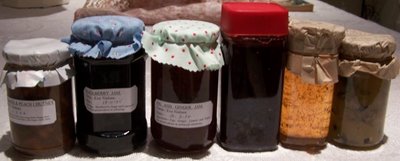
My local parish church is St Thom's and every few months they have a street stall at the Maxi Supermarket at Upper Ferntree Gully. It is something and is organised by the indefatigible fundraiser in chief, Gwen Brideson. Three tables. One table was burdened with beautiful knits and crafts. A second table groaned with delights from the kitchen. The third had the piece-de-resistance, the raffle of Rosemary Sendin's Mother's Day cake. Miss Eagle made a valiant effort to win this, purchasing quite a few tickets. But the winner was Iola Tilley - without whom St Thom's would probably fall down - who has more counts towards motherhood than Miss Eagle. But Miss Eagle always heads for the preserves. This time - with a vision of all those scones to be baked and tested for the Great Aussie Scone Fest - your author was even more focussed than usual. Miss Eagle does not bother to make her favourite Plum Jam anymore. Bett Connop's is a delight and this time it was made from Blood Plums. The other purchases all came from the kitchen of the elegant Eve Nielsen and, as you will see Dear Reader, her jams and chutneys are elegant as well. Six jars of Eve's produce came back to The Trad Pad: Apple and Sage Chutney; Nectarine and Peach Chutney; Lemon and Fennel Jelly; Fig and Ginger Jam; Gooseberry and Plum Jelly; and Blackberry Jam.

Friday, February 10, 2006

Tomato Relish

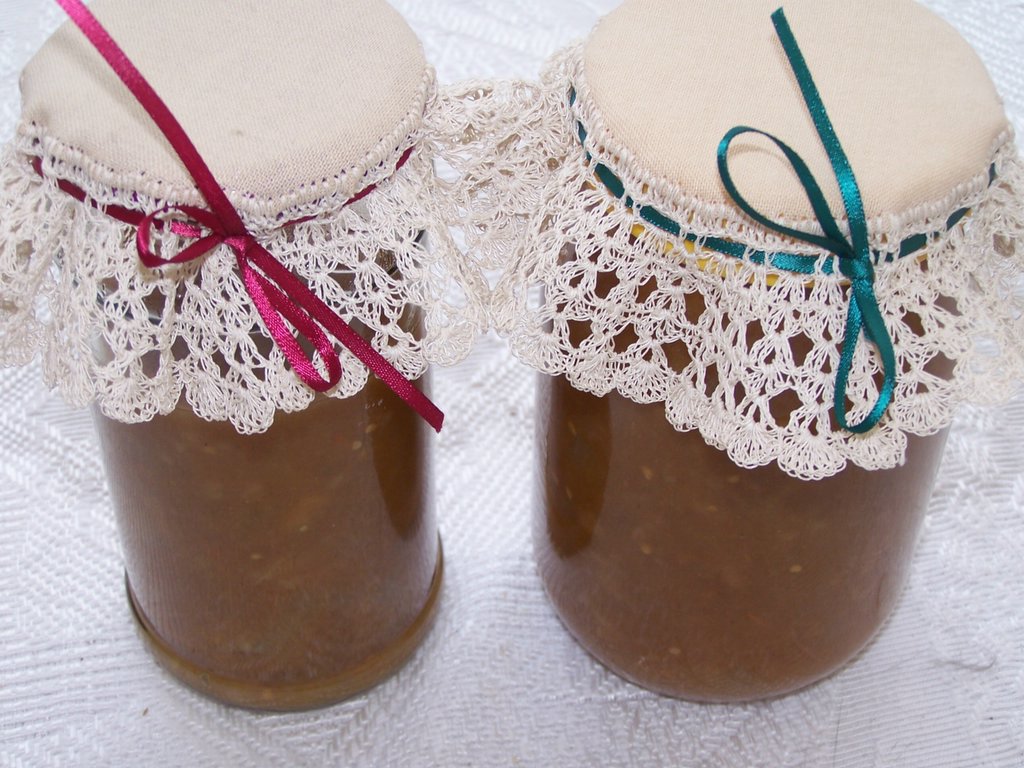
I grew up in Bowen, at the northern end of The Whitsundays in North Queensland, which is the winter tomato capital of Australia. The crop is croppin' and so it is Tomato Relish time. The recipe comes from the Bowen Methodist Ladies Cook Book which I acquired as a new bride back in the '60s. That cook book has long since disintegrated - it was roneo-d long before the advent of photocopiers. Even the Methodist Church does not exist. It joined with the Presbyterians and the Congregationalists to form the Uniting Church. The recipe continues now in my hand written cookbook - once-bound but now loose-leafed - and on this blog and hopefully into the recipe books of others. This relish was made from my crop of yellow tomatoes. Red tomatoes make a red relish. Yellow tomatoes make a brown relish - but just as tasty and yummy. This relish is great on cold meats, bread and butter, or mashed potatoes.
TOMATO RELISH
2kgs (4.4 lbs) Tomatoes
500 grams (1.1lb) Onions
500 grams (1.1lb) Sugar
1 tablespoon of dry mustard
1 tablespooon of curry powder
1 handful of salt
Vinegar (I prefer the brown malt variety)
Cayenne to taste (I was out of cayenne so used Chilli Powder. A great substitute)
Cut tomatoes and onions small and place in a dish. Sprinkle salt over. Stand overnight.
Next morning, pour off the liquid and cover the tomatoes with vinegar and put on to boil.
Cook 10-15 minutes.
Mix curry and mustard with some cold vinegar.
Add to tomatoes together with cayenne and sugar. This mixture will be runny.
If you wish to thicken it, mix the desired quantity of plain flour (all-purpose in the USA)
with vinegar into a lump-free paste.
Boil all together for 30 minutes stirring well and often so that it doesn't stick to the pan.
Bottle hot.
Enjoy!

ShareThis