Animals Australia: the voice for animals

Animals Australia: the voice for animals
Love life? Love all of life
Showing posts with label Meat. Show all posts

Wednesday, November 24, 2010

Thinking about your food: a school grows and kills its own turkeys - and the ramifications

I

I don't know how many schools in Australia operate like the Arthur Morgan School, in North Carolina, USA.  I found this article about growing and killing your own turkeys for Thanksgiving - and the ramifications of this decision - of great interest.

The issue of raising and killing animals, for those at Arthur Morgan School, turned into controversy, discussion, in-school politicisation and became "a rich experiential tool"  to teach children about ethics, economics, health, and the environment.

What I took from my reading of the article was how deeply the students and school community thought about their food - and the violence that is attached to eating animals for their meat.


I know there are people in Australia working in schools to turn attention towards food - not least of whom is Stephanie Alexander through her Kitchen Garden Foundation.  I don't know whether there is in-school experience of raising animals for food except for the sort of program similar to Ironbark, which is part of St Peter's Lutheran College. My daughter had a wonderful term at Ironbark when she was at St Peter's. 

Do Tucker Lovers know of Australian schools where this is happening?  

If animals are being raised, what occurs in regard to slaughtering the animals for food?  How is this handled?  Is there the same level of discussion about killing and violent death as has occurred within the Arthur Morgan School community?


As someone who wants people to think more about 
  • what they eat
  • where it comes from
  • how it is produced
  • how it comes to store and table, and 
  • the ethics involved in all of this 
I would be interested to hear of the experiences of others.  Just drop me a line at misseaglesnetwork(at)gmail(dot)com.


Photobucket

Saturday, June 23, 2007

Meatloaf Glaze and Orange Meringue Tart

Miss Eagle and Herself are a mother and daughter: two single women. So sometimes food is "catch as catch can" but we do have a few proper meals during the week. Some meals are prepared by Herself. Herself is a good cook but is not into food preparation in a big way. Miss E prepares some and now, being at home all the time with Herself as the worker, tries to do the maternal putting-a-decent-meal-on-the-table-for-the-hard-worker thing.
Herself has not yet taken the plunge into a meatless diet although she recognises that would be preferable. She gives two reasons: her susceptibility to iron deficiency and her acculturation to a meat diet. So Miss E does prepare carnivore food - usually about once a week - in consideration of Herself although she does note some decrease in beef consumption in Herself's diet. So, during this week, Miss E prepared a small meatloaf: something she hasn't cooked in at least two decades. The rainy, cold Melbourne weather this week has meant that good, old fashioned, solid comfort food is much appreciated. So the meatloaf came served with mashed potatoes, mashed pumpkin (Australians regard pumpkin as a vegetable more than a fruit), and peas. Miss Eagle always glazes her meatloaf and this time used a different ingredient because there was no brown sugar in the cupboard. The recipe for the glaze is below. Miss E presumes you all have your own favourite meatloaf recipe stashed away somewhere.
MEAT LOAF GLAZE

Ingredients + Method:

  • 1/4 cup of commercially prepared tomato sauce/ketchup
  • 1/4 cup of commercially prepared barbecue sauce
  • 1 teaspoon of commercially prepared mustard
  • Worcestershire Sauce to taste (1/2 teaspoon to 1 teaspoon perhaps)
  • (The sauces can be varied to taste - chili sauce for instance)
  • 3 rounds of palm sugar (would usually use about 1 tablespoon of brown sugar)
  • Mix together until sugar is dissolved.
  • If using palm sugar, you will need to heat ingredients in a pan and keep stirring until the palm sugar rounds dissolve.
  • Brush over meatloaf

Dessert was Orange Tart served with custard. The oranges that were used were Australian grown Navel Oranges. These are the most readily available oranges in Australian food markets. Citrus growing has been problematic in Australia in recent years and we have watched with sadness as many growers have uprooted their trees. Australians are amazed at this - particularly when they see Californian Navel Oranges in the supermarkets on occasions. In the last year or two though, there has been a focus on Australian-grown fruit and vegetables and, generally, food markets are taking pains to label the national origins of produce. It is not clear to all of us how beneficial this is to Australian growers overall and we do know that some fruit canning companies have gone out of Australian hands in recent years and a lot of fruit products list on their labels that they are constituted from local and imported products. In spite of the severe and prolonged drought experienced in Australia through which our food producers have battled, Australians still think of their land as a land of plenty and food sufficiency. So, many of us are saddened when basic food lines come from elsewhere. Now to the Orange Tart. First a disclaimer. Miss Eagle is not copycatting Ahn at Food Lover's Journey. Miss E has only caught up with Anh and her marvellous Candied Orange Tart this morning. Perhaps because we share the same Melbourne weather, the need for Orange Tart was on the wind! Anh's tart looks wonderful with candied orange slices so Miss E resolves to try this one out. Miss Eagle's Orange Tart has been tweaked from Amy Schauer's Orange Tart in The Schauer Australian Cookery Book (p.413) so the ingredients below are Miss E's.

ORANGE TART

Ingredients

Pastry. (Miss Schauer calls this Cake Pastry. My mother called it Biscuit Pastry. The reference to cake/biscuit is because of the method which begins with creaming the butter and the sugar)

Ingredients

  • 3 oz butter
  • 4 oz sugar
  • Vanilla (a capful)
  • 1 egg yolk (save the white)
  • 6 oz self-raising flower
  • 4oz milk (approximate)

Method

  • Cream butter and sugar
  • Add vanilla
  • Add egg yolk
  • Fold in flour and milk alternately
  • Line a pie dish. The one I used is approximately 1" deep and 8" across the base.
  • Please note this pastry can be difficult to handle. In summer, it may be best to refrigerate before rolling it out. The pastry is very short and it may not be possible to roll the total amount around your rolling pin to place across the pie dish in one movement. You may have to put the pastry in to the dish in pieces pressing them together.
  • Bake blind in a very moderate oven until golden.
  • Remove from oven
  • Cool and then fill.

Filling

Ingredients

  • 1 cup sugar
  • Juice of 2 large oranges
  • Juice of 1 lemon
  • 1 cup water
  • Pinch of salt
  • 2 egg yolks (save the whites)
  • 2 good tablespoons of custard powder
  • 1 teaspoon butter

Method

  • Place all ingredients in a saucepan and bring to boil stirring until boiling.
  • Let the mixture just begin to thicken (don't boil for too long or mixture will be too thick or may even go lumpy)
  • Pour into baked pie case.
  • Cover with Meringue

Meringue

Ingredients

  • 3 egg whites that have been retained
  • Caster sugar (4 to 6oz approximately)

Method

  • Beat egg whites until peaks form
  • Add sugar a dessertspoon at a time, waiting until each addition is beaten in and dissolved before adding the next.
  • Spread over cooled filling.
  • Bake tart in a moderate oven until the meringue is set and lightly browned.

Following Anh's example, Miss E will be participating in Sharmi's blogging event A Fruit A Month.

Wednesday, June 06, 2007

Over at The Elegant Sufficiency, Stephanie has drawn our attention to a grave ethical problem in the eating habits of human beings. Miss Eagle is a great lover of Chinese culture and food. Chinese cuisine is the pinnacle for Miss E. But Miss E deplores the depredation of whole species to meet Chinese demands for exotic foods and traditional medicinal ingredients. Miss Eagle's health has not been the best in recent times and she has considered resorting to traditional Chinese medicine - but there is a major hurdle. The impact of Chinese medicine on animal life. Read here and here to add to your understanding, dear Reader.
However, while one can recoil in horror at these tales, one also has to question our own Australian ethics in regard to our Standard Australian Diet.
We are wrecking our land. None of us question that anymore. Part of the wrecking of our ancient and fragile soils has been the importation of hard hooved animals. Sheep and cattle undergird the carnivorous diet favoured by most Australians. Goats and camels run wild in large numbers in the inland of Australia far from the eyes of the comfortable congregating in the urban fringes. The Northern Territory sends more cattle overseas in the inhumane live export trade than find their way to Australian slaughter houses.
What are the ethics involved in supporting the diet of most Australians?
For information about beef, cattle, sheepmeat, sheep, and goats go here. If you want to know more about live animal export, please go here.
As Jim Mason and Peter Singer point out (see sidebar), ask questions about your food - where it comes from, the means of its production - and ask questions about the treatment of animals and survival of animal species. Animals share this planet with us. We owe it to them. We owe it to ourselves.

Sunday, July 16, 2006

Brigid's Butcher's Blarney

Brigid's Butcher's Blarney
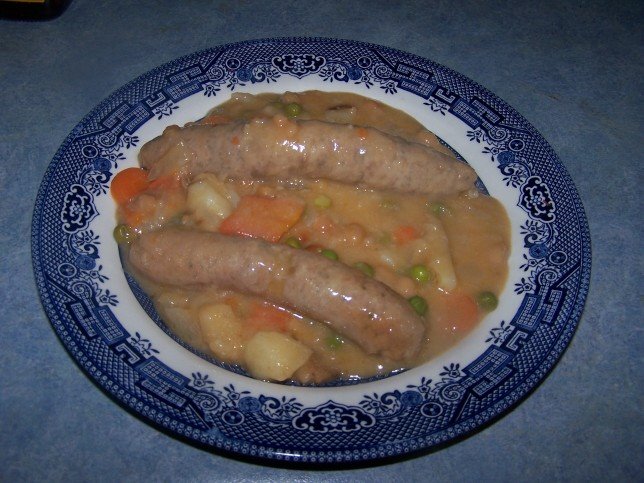
The weather here is Melbourne miserable. It has been damp and icy cold and as Miss Eagle looks out the office window the usual view of the Dandenong Ranges National Park is obscured by fog - or is it ground level cloud? So the evening repast calls for something simple, nourishing and nurturing. Hence, Brigid's Butcher's Blarney. Any good thick snag will do. These ones the butcher calls Irish Sausages. Why, Miss Eagle is not sure. Because they are pork, have a shamrock in them - or is it all indistinguishable blarney? Now quantities are not given here. Sort yourself out according to taste and quantity required. Use any thick sausages (thin ones aren't so good in this dish) and cook them in the manner described here. They don't have to be cooked through - but brown them well. Remove them from the pan. Saute onions and garlic. Make a gravy by adding flour to the oil and sausage drippings and then water. Because this is simple and relaxed, we are using froz veg - so choose your favourite (Miss Eagle's fav had cauliflower, carrot and peas) and add to the gravy along with some diced potato. But the thing that distinguishes the flavour is the addition of baked beans in tomato sauce. Now there are all sorts of varieties of baked beans on the supermarket shelf - but just choose the old fashioned sort in tomato sauce. No cheese. Add salt and pepper and, if you are going gourmet, any suitable spices you fancy. Simmer gently until the sausages along with the potatoes and veges are cooked through and tender and the gravy is nicely thickened. Keep your eye on it and add water if necessary. Serve, curl up before a blazing fire or a warming gas duct and enjoy!
This is not so posh nosh - but it doesn't take much dosh!

Wednesday, June 21, 2006

No beating, no pricking..please.

Photobucket - Video and Image Hosting

Photobucket - Video and Image Hosting

In Miss Eagle's family home, there were two cookery crimes. One was beating meat with a mallet or a rolling pin with the aim of tenderizing it. The other was pricking sausages prior to cooking in the belief that this would prevent sausage meat oozing from its skin. You see, dear Reader, Miss Eagle's father was not only a great cook - as was her mother - but he was a trade-qualified butcher in the early part of the 20th century when the training was quite extensive. On beating steak to tenderize it

Jack O'Carroll, Miss Eagle's father, believed that no amount of beating could make a tough steak tender. In fact, one of the effects of beating steak was to expel the juices from the steak which tenderized it during the cooking process. How to get a tender steak:

  1. Choose a cut of steak appropriate to the cooking process. For instance, topside and round steaks are not grilling steaks. A corner piece of topside makes a very good roast. Sliced topside and round steak are best cooked slowly in casseroles, stews, and curries. Similarly, one would not bother to use Scotch or Rib Fillet or Eye Fillet in a casserole. These cuts are best suited to grilling or pan frying (dry frying). Rump Steak is quite versatile. It is a superb grilling steak. As a whole rump, it can be a beautiful roast. Sliced, it can go well in a casserole. However, rump is usually more expensive than topside or round so one would not bother using such a cut in a casserole when a less expensive cut would do as well.
  2. Understand how to cook meat. Understand the cuts of beef. In this day and age, there is a great demand for lean beef. Fat marbled through beef is what contributes to its tenderness. The way a side of beef is hung by a butcher and the length of time it is aged contributes to its tenderness. Miss Eagle, as her father and grandfather (a livestock auctioneer) before her, has a preference for beef from Poll Shorthorn cattle. Indeed, Miss Eagle believes the beast should not have to walk far to eat and its food should be unstinted lush green grass. Such a beast produces beef that is not red but purple with creamy specks of fat marbled through it. Now that is tender beef.

On pricking a sausage to prevent it oozing

  1. In these modern times, sausage casings can vary from the natural product to the synthetic. Again, the secret is to learn about sausages. Know what a quality sausage is. And you can't go past a German butcher to teach you. Miss Eagle's paternal grandmother always had a German butcher hovering in the background.
  2. Learn how to cook a sausage. Pricking sausages does not prevent oozing if your sausage is cooked incorrectly or the casing of poor quality.
  3. To cook a sausage properly and well, pour a small quantity of Extra Virgin Olive Oil across the base of a heavy frying pan. Place the sausages in the pan. Turn them to coat them in oil. Then place them on the hotplate or burner and turn on the heat. Yes, start cooking the sausages cold and turn up the heat slowly and gently. Heat is applied slowly and gently so that the sausages adjust slowly to the cooking process. Only when the sausages have plumped up gently in this way can the heat be turned up further to complete the browning and cooking process. In this way, you will have a fat, juicy sausage which does not pop its skin.

Tuesday, June 13, 2006

Beef Olives

Photobucket - Video and Image Hosting

When Miss Eagle was but an eaglet and doing Domestic Science classes in Grades 7 and 8, one of the earliest items in the repertoire was Beef Olives. This was the time when the Sunday Roast and Three Veg reigned supreme. The height of culinary achievement in the Australian home at that time was the baked dinner. Now Beef Olives is a way of doing a simple baked dinner - a baked dinner on a budget, a baked dinner that did not take as long as the Sunday joint, a baked dinner simplified. In this day and age, it is even simpler to do. The Kitchen Whizz/Food Processor takes care of the seasoning/stuffing. A convection oven - or even a microwave - can speed up the cooking time. Here is Miss Schauer's classic recipe.

BEEF, VEAL, OR MUTTON OLIVES WITH GREEN PEAS
Lay out flat 1 1/2lb of topside, badebone, or round steak, cut thin. Beat with a wet rolling pin to soften fibre. Cut steak into square pieces 4 in. x 4 in. Spread with a dessertspoon of minced bacon and shredded carrot, and dessertspoon of minced onion with a pinc of saslt and pepper. Cover smoothly with a thin layer of stuffing, made by soaking a cup of fresh breadcrumbs and a tablespoon of finely-cut parsley, seasoned with pepper and salt, mixed together with 2 tablespoons hot milk. Roll round carefully (neatly). tie in middle and ends with twine or fine string. Brown quicky in pan, in a little hot fat, all over. Place in casserole, pie-dish, or thick saucepan. Cover closely. Cook slowly about 2 hours in oven or on top of stove. Remove rolls, place on hot meat-dish. Arrange a tablespoon of hot cooked green pease between the rolls, showing on top of rolls, or a 4 in. slice of cooked carrot. Pour a teaspoon of melted margarine over vegetables. Garnish side with sliced tomato, with a touch of shredded lettuce on each and shredded lettue at end of dish.
NOTE:- The stuffing may be placed on one half of the steak, the other half folded over to form a sandwich. Prepare, cook and serve as above.
Fibre of meat may be softened by probing surface with edge of thin saucer, or end of rolling pin before stuffing and rolling.
Miss Eagle's Notes: After removing the Olives from the frying pan after browning, Miss Eagle makes a nice brown gravy (remember NO GRAVOX) using a little Parisian Essence to darken the gravy if necessary. The gravy can have additional liquid so it is rather thin. Pour the gravy over the Olives in the casserole dish and place in oven. The gravy will reduce and thicken. Keep an eye on the gravy so that it doesn't simmer away. Because of the gravy, Miss Eagle likes mashed potatoes with her Olives, along with some cauliflower and minted peas.

Monday, June 12, 2006

On the menu 2: Oxtail Stew

Photobucket - Video and Image Hosting

Oxtail Stew is highly nutritious: meat, bones, and vegetables.

Once upon a time, an oxtail was bought whole - so that the purchased would get the large thick bones from the top of the tail and the fine, thinner ones from the bottom of the tail. Now this can still happen if you have the good fortune to use a good, old fashioned butcher. But if you are used to purchasing your meat at the supermarket all wrapped and stacked, then I need to explain this. Because what can happen with the pre-packaged oxtail is that you may not get the whole tail. This is what happened to Miss Eagle as she purchased her oxtail at Woolworths one weekend when the good old fashioned butcher was closed and the butcher in the shopping mall tried to sell her a pickled ox-tail - whatever that may be. Miss Eagle picked up a pack labelled "Tail" not "Oxtail" and thought it was awfully small. There should be more to it than this. And the bones were small. Miss Eagle looked again and there was another pack on the shelf with the large bones in it - so Miss Eagle had to purchase two packs to make one oxtail. The modern handling of beef!

The picture above shows the whole oxtail lying on a bed of vegetables. Mushrooms were added later. You can, if you wish, throw the oxtail and your choice of vegetables into a big pot and cover with water and salt and simmer away until ready. However, Miss Eagle prefers the following method.

Take a baking pan and layer your vegetables. The very first to go in is Cabbage, sliced and laid across the pan. Other vegetables are, Carrots, sliced into rings, Celery, chopped finely, a few Celery Tops, Onions, Potato, Mushrooms, and Garlic. On top of this place the Oxtail so that it looks like the photograph. Bake in a low oven (about 105 degrees Celsius) for about an hour. If the oxtail is very fatty, the fat will go to the bottom of the pan and can be drained off. Keep an eye on the baking, you don't want the vegetables to catch. Then, add your choice of herbs, don't forget the salt, and put in a large pot and bring to the simmer on the top of the stove. If you have a large cassoulet pot, this could be done in the oven. Now Miss Eagle needs to tell you that she considers Oxtail Stew a two-day event. This is to do the ever so slow cooking on Day 1. Then next day drain off any fat that has solidified on top of the stew before re-heating, thickening the stew with a paste of Plain Flour and water, and serving. With slow cooking food, it is - more often than not - better on Day 2 when you will find a greater enhancement of flavours. When your Oxtail comes to table the meat should be falling off the bone. Now this is beautiful served just with a sourdough bread and butter. However, there are two enhancements that can be made either alone or together. Give the Oxtail a hint of Central Europe by adding sour cream and stirring well in to blend about ten to fifteen minutes prior to serving. The other is to take your favourite scone recipe (see Miss Eagle's Scone Fest recipes) and do one of two things. If you are finishing the stew on your stovetop break off the dough and roll into balls (a bit of parsley is just the thing in these dumplings) place on top of stew and put a lid on top. These will cook in ten to fifteen minutes. Needless to say you do not have to serve bread with this. If you are finishing the stew in the oven, cut out the scones as usual and put on top of the stew. Do not put the lid on the pot. The scone topping will be moist underneath and brown on top and will cook in ten to fifteen minutes if you turn the oven up a little. Bon appetit! Scrumptious!

Photobucket - Video and Image Hosting

Sunday, April 23, 2006

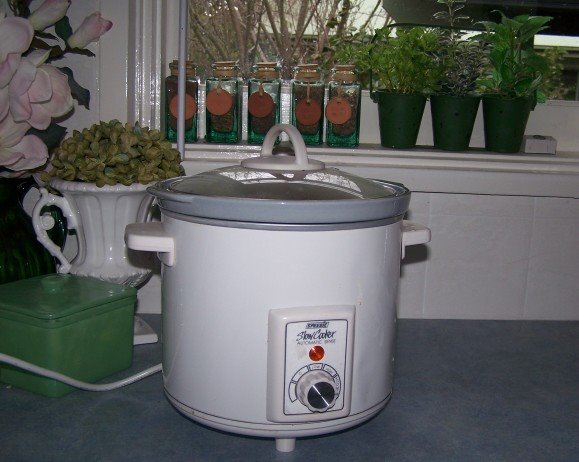
Slow cooking food 2 - Soup

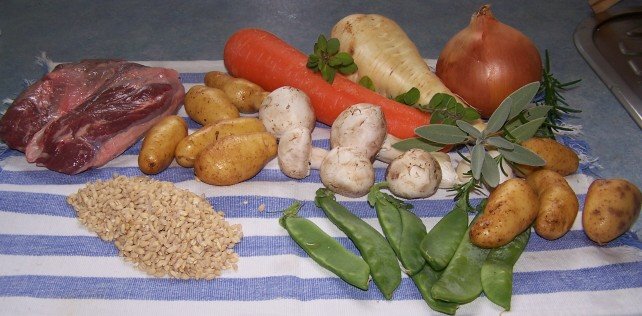
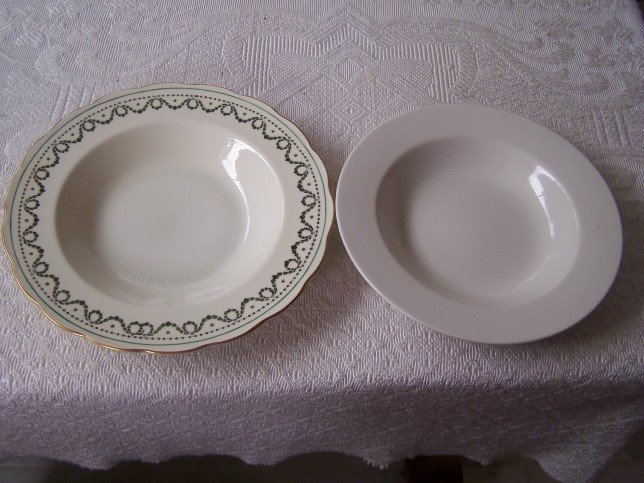
Miss Eagle's traditional beef soup is beautifully rich and thick and has been simmering slowly for almost 24 hours. The beef is shin beef - otherwise known as gravy beef. Shin beef is used in making soup because it makes a rich beef stock which is highly nutritious. Years ago in nursing courses and in primary school domestic science there used to be a subject called "Invalid Cookery". One of the highlights of invalid cookery was something called Beef Tea. Shin beef was used in this. Beef Tea was designed to put nutrients into the body weakened by illness. Miss Eagle dices and trims the beef so that nice tender morsels of beef are part of the soup. The potatoes are Kipfler Potatoes otherwise known as German Finger Potatoes. Kipflers are a waxy, finger shaped potatoes with creamy-coloured flesh. Great boiled, steamed and in potato salads and for presentation purposes. Miss Eagle likes them for soup because they are small and irregularly shaped. She leaves them whole but chooses the tiniest of them so they go well in a traditional soup plate. And speaking of soup plates. Miss Eagle loves the traditional soup plate with the wide brim about the edge. Certainly not a deep bowl - and mugs are only for when one can only manage the chemicals in hot water known as cuppa soup. You see, there is a reason why a soup plate is large and broad and shallow. It is because it keeps soup at the right temperature - neither too hot, or too cold. If it is too hot to start with, it cools quickly. As for the wide brim, it can hold a morsel of broken bread.

Image hosting by Photobucket Miss Eagle prefers her very old Crescent English bone china plates. But if you can't get any vintage soup plates, Maxwell Williams does a satisfactory, but slightly smaller, modern version in the famous plain white.

The herbs are fresh from the garden as with the Lamb Shanks and Macaroni. The other vegetables are onion, parsnip, and carrot (a feast of nutritious root vegetables) and mushrooms and snow peas. The little heap of grain to the left is pearl barley.

One thing Miss Eagle must say about the soup, the shanks and when you bake bread and pudding: you decorate the atmosphere of your home with aromas to die for, the aromas that become memories forever after, aromas that make one's mouth water, and make one hungry for all that is good and nutritious.

Slow cooking food 1 - Lamb Shanks with Macaroni

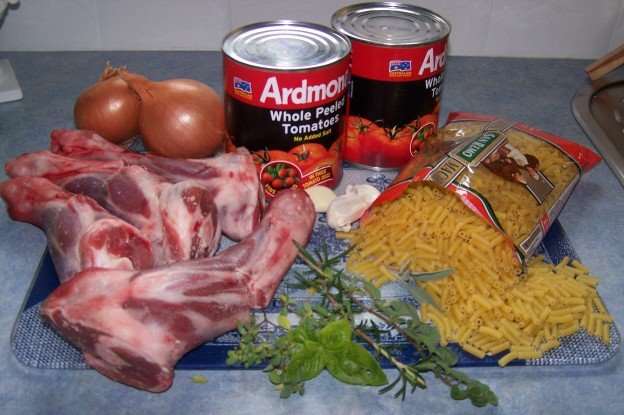
In Melbourne, the weather is closing in dark and cold and often rainy. It is the time to think of the sort of food that warms the cockles of one's heart. The slow cooking sort, substantial and comforting. This means the time for our favourite autumn/winter meal, Lamb Shanks with Macaroni. These are the ingredients...
...and they are all Australian - the containers and packaging are marked "Product of Australia". Note the little Aussie flags on the Ardmona tins. The herbs, except for the garlic, are freshly picked from the garden - basil, sage, marjoram, oregano, rosemary. Miss Eagle leaves the shanks whole - to be picked up in the fingers and gnawed on, so large napkins are in order. Here are the Lamb Shanks ready for the oven. Oh, and by the way, Miss Eagle has added some mushrooms that are not in the above photograph. The copper bottomed stainless steel casserole belonged to my aunt. I don't use the lid for this dish. The casserole is cooked very slowly: 200 degrees Celsius to start with until the liquid starts to simmer. Then turned back to 150 degrees Celsius and cooked ever so slowly until the meat is falling away from the bone. Some additional water is needed during the cooking because the macaroni takes up quite a bit. The only way this could be better would be if it was cooked in a slow-combustion stove.

Scrumptious, warming, and FootFoot and Trixie love to chew on the bones.

Monday, January 30, 2006

A rissole by any other name should taste as good...

Barb over at Woof Nanny and Dog-eared and Underlined mentioned in a comment on a post below about how she enjoyed knowing the different names there are for things in different countres. This got me thinking. Rissoles I thought. Hamburgers in some times and places but in the Land of Oz they always were, and continue to be, rissoles: tasty, cheap, nutritious. ~~~~~~~~~~~ RISSOLES

Put 1kg (2.2lb) of mince (ground meat or hamburger in the US) in a bowl. There are different grades of mince but the best are those labelled Premium or Heart Smart. You will pay more for this quality but the less you pay the more fat and trimmings you get and the less quality. To the mince add: 2 slices of bread (fresh or stale) soaked in water and the water squeezed out so it is squishy and mushy; 2 onions finely diced; fresh or dried herbs of your choice and to your taste (to-day I used fresh marjoram and sage that grows in my garden); garlic to your taste sliced or crushed - I love garlic, so I used four cloves; Worcestershire Sauce (pronounced Woostersheer) and salt (hope you use iodised salt) and freshly ground pepper. The bread and the eggs are used to bind the mixture together so it doesn't break up when it hits the frying pan. Some people use flour instead of bread - but in our household the tradition is to use bread. Squish the mixture together. Then take dollops of the mixture in the palm of your hand and shape. Don't make too flat - looks awful. Don't make too fat - takes a bit of trouble to ensure it is cooked through. There are dreadful jokes in Australia about shearers' cooks who shape rissoles under their armpits! Roll the shapped meat in plain (all-purpose) flour and cook in moderately hot oil (you are using extra-virgin olive oil aren't you?). If your oil is too hot the outside will cook quickly but the inside won't be fully cooked. If you have your oil too cool the oil penetrates the rissole (greasy yuk) and the rissole will be a pale unappetising colour. Golden brown with a lightly crisp outside is what you are aiming for. Having said all that - now you have the general idea you can vary this however you like. Some people add grated carrot. Some use different sauces to flavour such as soy sauce. You can roll the shaped meat in flour, egg and breadcrumbs before frying - now that does add the kilojoules/calories! But the way I have given it to you is how we like it at our place. It is served with mashed (in the US they say riced) potatoes and peas - sometimes those wonderfully mushy peas you have with pies. Some people like barbecue sauce on their rissoles, others favour that great Aussie condiment, tomato sauce (ketchup in the US). If I was to bung it on (that means dress to impress, if you get my meaning) I would do a lovely brown onion gravy (the secret of the gravy is the use of Parisian essence - never use Gravox). Scrumptious! Comfort food! But if you are a vegetarian and turning up your nose at the meat - then substitute your favourite veges or beans for the meat and off you go with the same method.

I'm sure what are called Rissoles in the Land of Oz are not limited to the wide brown land as Australian as we may think and feel they are. Please add your exotic spice to this recipe post by telling us what you do in your country and what you call your Rissoles. Someone might also be able to enlighten the rest of us about where the word "rissole" comes from. Is it a word from some exotic cuisine?

ShareThis