Animals Australia: the voice for animals

Animals Australia: the voice for animals
Love life? Love all of life
Showing posts with label Animal suffering. Show all posts

Friday, March 15, 2013

Meat Free Week 18-24 March: put yum in your tum with fruit and veg!

Just want to let you know that next week is Meat Free Week 
and Sustainable Table has a free booklet for download 
that will really help you out!


Hi there,


Hold on to your broccoli stems kids, next week is officially Meat Free Week, 18 - 24th March! It's a week in which we can celebrate a culinary world sans animal flesh. "Lamb chop move aside, it's MY time to shine," (said Mr Beetroot).

In all seriousness, Meat Free Week is an opportunity to think about how much we consume. In case you're wondering, we need to think about this because as a nation, we're consuming way too much. Even the Australian Institute of Health and Welfare agrees - the latest Australian Dietary Guidelines stress that we need to halve our meat consumption immediately. The amount of meat we are eating annually - 120kg per person or 190,000 tonnes nationally - is putting pressure on our environment and our farmers. Carbon, nitrogen and methane emissions, water use and ethically-questionable intensive farming practices result.


What to do and what to cook


The good news is that contributing to a brighter future for our environment, animals and farmers isn't that hard. It simply involves eating less meat (purchased from small, local and ethical farmers) and more vegetables and stuff. By stuff we mean highly nutritious yet super cheap protein sources like beans, lentils, quinoa and other seeds and grains. 

To help you prepare and enjoy Meat Free Week, we have developed  absurdly useful FREE recipe booklet that we've designed to cover ALL your meals anfor the week. That's 21 meat free recipes at your fingertips - 7 breakfasts, 7 lunches and 7 dinners. It's a trifecta! The booklet also includes a handy shopping list. 

Share your photos & win

Of course we have a competition! Share your photos of the meat free recipes you cook from our booklet and be in with a chance to win a copy of our award-winning book The Sustainable Table, valued at $40.  Here's what you need to know:

Take snaps of your pretty meat free dishes and share with us either on Facebook or Twitter. Be sure to tag us on Facebook using @TheSustainableTable or on Twitter using @SustainTable. At the end of the week we'll select the top 3 prettiest pics and draw a winner! Entries close COB 10pm Sunday 24th March 2013 EST.


You can fundraise for Voiceless too

Get your friends, family and workmates to sponsor you for the week and the money will go towards supporting the work of Voiceless

If you're vegetarian or vegan

You can still get involved by encouraging others around you to take up the challenge of a meat free week. Here's a few ideas.


For more information and 
to download your FREE copy of A Meat Free Week, 
visit our website here.
 

Thursday, October 27, 2011

Non-stunning slaughter - Animals are counting on you to be their voice


As you know, a big decision will be made this week when primary industries ministers from around the country meet in Melbourne to decide whether to close the loophole on non-stunned slaughter in Australia.
I'm writing to invite you to an important rallyorganised by Animals Australia on Thursday evening at the MCG, where the ministers are due to discuss their decision on this issue. Already 14,000 Animals Australia supporters have written to these ministers imploring them to show mercy and remove the exemptions that are allowing some abattoirs in Victoria and South Australia to cut the throats of fully conscious sheep. We need your help to send one last and all-important reminder as the ministers arrive for their dinner meeting, that caring Australians are depending on them to make the right decision.
  • Where: Gate 2, Melbourne Cricket Ground
  • When: 5:45pm, Thursday, 27th October (finishing 7pm)
  • What to bring: Just yourself, we will have plenty of posters for people to hold
  • More information: Call the Animals Australia office on 1800 888 584
Miss, of all the cruelty I have seen inside abattoirs, non-stunned slaughter of animals represents the single greatest cause of distress, pain and suffering I have born witness to.
Fortunately we understand that several ministers are already of the opinion that non-stunned slaughter is unacceptable, which means there is real hope to end this brutal practice in Australia. This rally may be the tipping point that gets the others over the line.
Please join our experienced campaigners for a peaceful gathering on Thursday evening and help us ensure that all animals in this country are extended this most basic legal protection.
LynI hope you can join us,
Lyn
Lyn White
Campaign Director
P.S. You may be aware that the official meeting of the primary industries ministers will be held on Friday morningWe are rallying at their Thursday evening dinner meeting as it is expected that their position will be determined at this time. I hope you can attend, but even if you can't, you can have your say on our website right now.

Monday, October 11, 2010

You're invited to attend a Live Export Forum 
organised by the City of Fremantle.
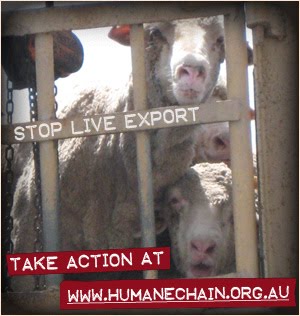
At the event you'll hear from a panel of speakers discussing the progress being made to end live export, why they're personally against the trade, and the effects it has on animal welfare, our overall economy, employment and Australia's reputation.
You'll also have the opportunity to participate 
in a unique public action to help end the trade!
Where: 
Fremantle Town Hall, 8 William Street, Fremantle
When: 
Tuesday 12th October 2010, 6pm, for a 6.30pm start
RSVP: 
Email humanechain@wspa.org.au by 11th October and let us know if you and any of your friends would like to attend.

Panel speakers will include:
  • Brad Pettitt, Mayor of Fremantle
  • The Hon. Melissa Parke, Federal Labor MP for Fremantle
  • Representatives from the meat processing industry and meatworkers union
  • The Hon. Lynn MacLaren, Greens MLC
  • Jessica Borg, Campaign Manager, WSPA
  • Jodie Jankevics, Campaign Manager, Stop Live Exports
We hope to see you there! If you are unable to attend please check back here on the Humane Chain blog for event updates, or follow our tweets from the forum. Please help us promote the event by re-posting this story on Facebook.


Photobucket

Wednesday, March 05, 2008

Tony Burke, we know more than you think about food

Dear Reader, I don't think they get it yet. I don't think the Prime Minister gets it. I don't think the farmers and their organisations get it. And it has become patently obvious that the Minister for Agriculture, Fisheries and Food, Tony Burke, certainly doesn't get it.
What don't they get? They do not understand, do not comprehend the interest ordinary, everyday Australians are taking in their food - its nutrition value, the way it is grown, who are the people who grow it, the impact of climate change upon it, and the impact of major domestic and international corporations on it.
It seems to me that the Australian government sees only major corporate entities: the farmers, their organisations; food distributors and manufacturers and their organisations; agribusiness and its organisations. Then their is that strange entity called "the consumer".
Now "the consumer" does not hold weighty conferences attended by all those listed in the previous paragraph plus agricultural researchers and economists. But, last time I looked, the consumer still had a brain, was still a sentient being, and is capable of making reasonable and clear decisions.
We see farmers organisations and their supporters drumming up the so-called "city/country divide". What is not recognised is the large numbers of Australians - who qualify only for the title of consumer - who have moved to the country to establish their own small holdings; who have built relationships with farmers - particularly through Farmers Markets; who are concerned with ethical eating and who are so supportive of the agricultural enterprise that they support drought appeals and angst together with rural residents over the mental health of the farming community.
Australia, with its mild climate across most of the continent, has always been home to keen growers of edible gardens. And most of these gardeners are trying to be organic. Many of them are keen students of permaculture and biodynamics. Lots of them could imagine puttingMonsanto and Dupont on trial for agricultural and economic terrorism but instead support seed savers groups and heritage varieties of fruits and vegetables. They are learning not to damage Australia's fragile soils with excessive tilling and their no-dig gardens are multiplying day by day. Primary Schools are teaching children about food from seed to souffle in their own kitchens and kitchen gardens - often aided and abetted by celebrity chefs.
The Minister seems to be entirely ignorant of this movement that votes with its green and dirty thumbs. Why else would he have come out with these statements? (Please take time to read the comments!) ABARE Outlook 2008 has been on in Canberra. The Minister made his views clear in a doorstop interview there:
REPORTER:
[Inaudible] campaigns against food miles, etc. Are you going to invest in advertising or is this something that you’re making comment about?
BURKE: Certainly, with respect to the animal welfare campaigns, there’s been ongoing investment – and I referred to some of it today – in trying to make sure that we are not just at world’s best practice, but leading world’s best practice in overseas abattoirs and the destination points of some of our live exports.
With respect to food miles, I think we have to take, as I’ve said today, every opportunity to let people know and to let the consumers, both in Australia and internationally know – and I took the advantage today when we had international press here – to make it clear that food miles is a system deliberately designed to deceive. It does not provide quality consumer information and preys on the fact that a lot of consumers – and good on them – want to make sure that they’re doing their bit in trying to reduce carbon emissions.
The problem with food miles is that it takes one tiny [inaudible] of an equation and that’s their entire answer.
So clearly the Minister has a limited understanding of the concept of "food miles": of being near enough to your food to shake hands with the farmer; of caring about freshness and nutrition and value-for-money goodness; and of cruelty free animal lives.
Miss Eagle's solution to these sort of things is - organise. After all, that is what the major corporations and their hangers-on have done. But Miss Eagle looks around and sees organisation: the organisations devoted to permaculture and biodynamics and organics; the increase in retail outlets distributing these types of food products; the countless books, blogs, journals and websites promoting the good, simple, healthy and sustainable life.
Such a mind-set takes one beyond the suburban picket fence mentality and the four walls of a boxy apartment. It takes one into a wider world where nature is valued, treasured, and studied with a view to greater understanding.
Perhaps one day this understanding will reach as far as the board table in the Cabinet Room of Federal Parliament (who will water a Prime Minister's and Minister's edible garden?) and find a forum at ABARE.
The Hon Tony Burke MP Minister for Agriculture, Fisheries and Forestry.
PO Box 6022
House of Representatives
Parliament House
Canberra ACT 2600
Tel: (02) 6277 7520 Fax: (02) 6273 4120

Wednesday, June 06, 2007

Over at The Elegant Sufficiency, Stephanie has drawn our attention to a grave ethical problem in the eating habits of human beings. Miss Eagle is a great lover of Chinese culture and food. Chinese cuisine is the pinnacle for Miss E. But Miss E deplores the depredation of whole species to meet Chinese demands for exotic foods and traditional medicinal ingredients. Miss Eagle's health has not been the best in recent times and she has considered resorting to traditional Chinese medicine - but there is a major hurdle. The impact of Chinese medicine on animal life. Read here and here to add to your understanding, dear Reader.
However, while one can recoil in horror at these tales, one also has to question our own Australian ethics in regard to our Standard Australian Diet.
We are wrecking our land. None of us question that anymore. Part of the wrecking of our ancient and fragile soils has been the importation of hard hooved animals. Sheep and cattle undergird the carnivorous diet favoured by most Australians. Goats and camels run wild in large numbers in the inland of Australia far from the eyes of the comfortable congregating in the urban fringes. The Northern Territory sends more cattle overseas in the inhumane live export trade than find their way to Australian slaughter houses.
What are the ethics involved in supporting the diet of most Australians?
For information about beef, cattle, sheepmeat, sheep, and goats go here. If you want to know more about live animal export, please go here.
As Jim Mason and Peter Singer point out (see sidebar), ask questions about your food - where it comes from, the means of its production - and ask questions about the treatment of animals and survival of animal species. Animals share this planet with us. We owe it to them. We owe it to ourselves.

Thursday, February 22, 2007

Where does it all come from?

J.M. Coetzee, Nobel Laureate, now resides in Australia. To-day there is an opinion piece in The Age: an edited version of a speech Coetzee will give in Sydney to-night. Here is an excerpt:
The transformation of animals into production units dates back to the late 19th century, and since that time we have already had one warning on the grandest scale that there is something deeply, cosmically wrong with regarding and treating fellow beings as mere units of any kind. This warning came so loud and clear that one would have thought it impossible to ignore. It came when in the mid-20th century a group of powerful and bloody-minded men in Germany hit on the idea of adapting the methods of the industrial stockyard, as pioneered and perfected in Chicago, to the slaughter - or what they preferred to call the processing - of human beings. Of course we cried out in horror when we found out what they had been up to. We cried: What a terrible crime, to treat human beings like cattle! If we had only known beforehand! But our cry should more accurately have been: What a terrible crime, to treat human beings like units in an industrial process! And that cry should have had a postscript: What a terrible crime, come to think of it - a crime against nature - to treat any living being like a unit in an industrial process!

Sunday, November 26, 2006

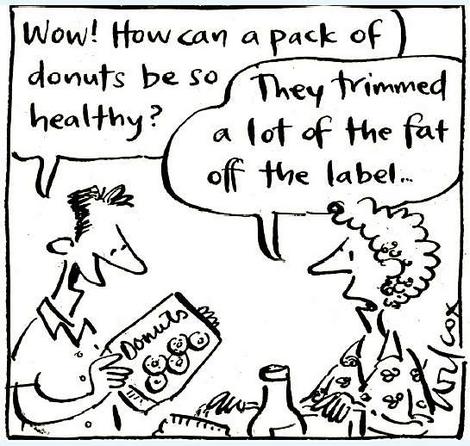
Food labelling: inadequate and deceptive

As far as Miss Eagle is concerned, one of the flaws of the inexact science of Economics is the supposition in the Theory of the Firm that the consumer has perfect choice. To Miss Eagle, it is a clear example that most theoretical economists are men who don't go shopping.
This is one consumer who is far from having perfect choice. Perhaps the buyers for retail firms come close to having perfect choice, but this consumer is dependent on making her choice from what retailers put on their shelves and when I am not able to get what I want, I know that the Theory of the Firm has failed to work once again. This is why I take labelling seriously. Miss Eagle is a label reader from way back. She also likes to have a bit of a handle on the companies - both retail and wholesale - who supply her food. Sometimes getting this information is not difficult or strenuous; sometimes it is nigh impossible. This is why Miss Eagle is most concerned about this week's news about labelling: inadequate and sometimes bordering on the deceptive. One thing that the consumer has to jack up on is the weasel words in our food promotion. Organic - can the consumer know or prove that this is a genuine claim. Should consumers be expected to pay a premium for organic food, particularly imported organic food from the USA that sits in cans and jars on the shelves of my supermarket. Natural - This is the word that drives Miss Eagle nuts. What does natural mean? The dictionary gives the following definition:
adjective 1 existing in or derived from nature; not made, caused by, or processed by humankind. 2 in accordance with nature; normal or to be expected: a natural death. 3 born with a particular skill or quality: a natural leader. 4 relaxed and unaffected. 5 (of a parent or child)related by blood. 6 archaic illegitimate. 7 Music (of a note) not sharpened or flattened.
Definition #1 seems to be the one to focus on in relation to food.
When advertising uses the word 'natural' what is the worth of the word. Miss Eagle suggests it has no value whatsoever. Everything we have on this planet has existed in or is derived from nature. Where else did it come from? Outer space? "Not made, caused by, or processed by humankind". Well, everything we have comes from God but how much comes to our table without being processed in some form by humankind? Most farmers use some type - organic or inorganic - of pesticide or herbicide. Then there are the industrial processes to which a lot of our food is subjected. There is human intervention at a variety of levels in our food chain, food processing, and food distribution. How can any marketer then use the word natural with honesty, clarity and exactitude?
Wholesome - How do we know? We don't know when the fruit and vegetables were picked. We seldom know where what we eat has come from, how far it has travelled, and how long it took to get to our table. What do we really know about nutrient content of our food when it gets to us? Can we take industrial processing of food for granted?
As consumers, we have allowed industrial methods of food processing and food distribution to enter our food production without much questioning. Basically, we like to purchase inexpensive food and we expect it to taste good, and we - at least in modern western industrial societies - expect the food to be available in the here and now, in season and out of season.
These factors are not the paramount ones we should be seeking when we are constructing a healthy and nutritious diet.
This is why labelling is so important: whether it is on fresh food or processed food; whether it is the unpackaged food purchased at a deli counter or the fresh food and vege purchased at farmers' and produce markets.
Consumers need to be savvy, demanding, and thoughtful of where their food comes from.
Take a look at food production in Australia. Be aware of how farmers are being squeezed by retail pricing and production costs and inputs. Be aware of how far agriculture and horticulture has retreated in this country and how we have allowed imports - even from the northern hemisphere - to invade our country and our food chain. And above all, let us all - producers and consumers - be aware of the ethics of food production and food consumption and the pressures both sides of the food chain place on humane standards. Why should animals suffer because of our demands for cheap, unseasonal, constant production?

ShareThis